I Quietly Baited a Tailgater for 5 Miles. It’s Not What You Think.
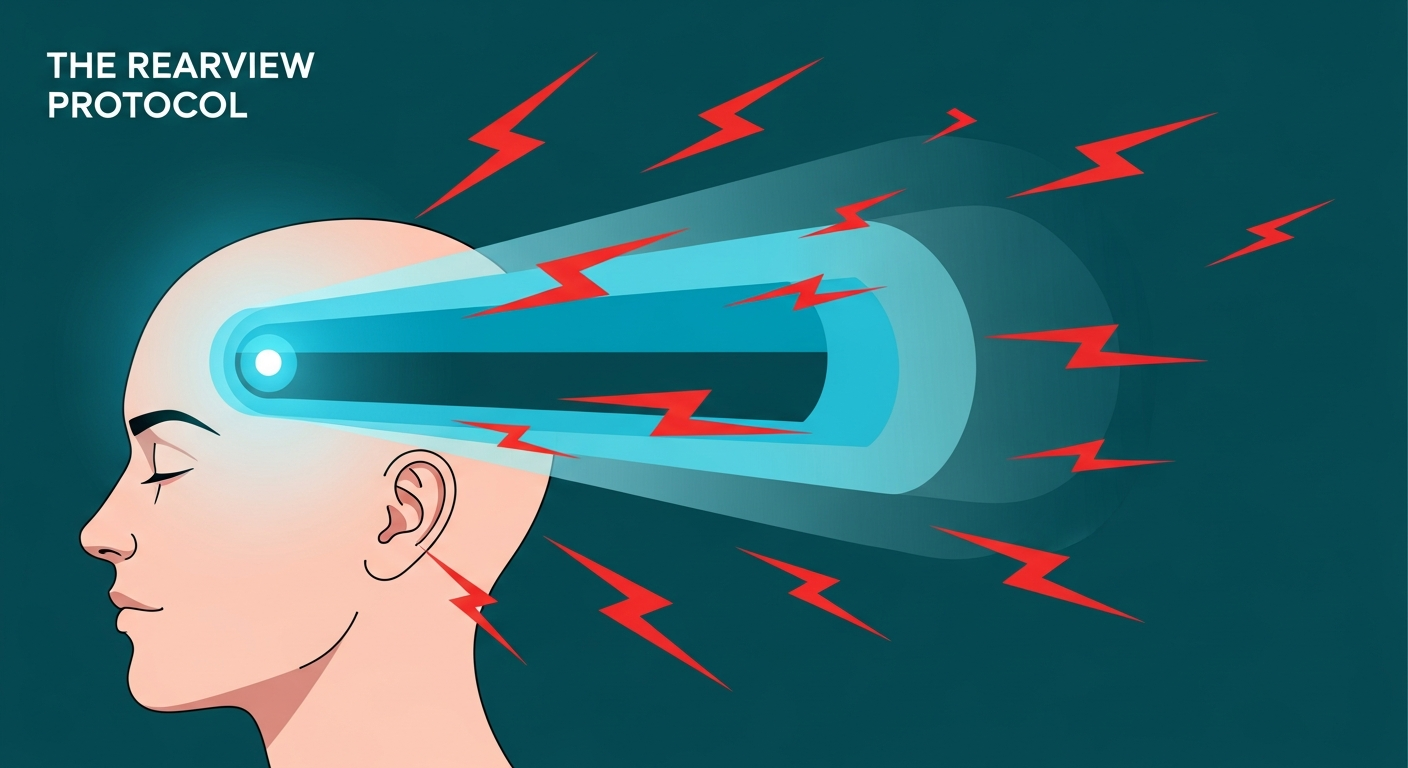
**I invited a total stranger to ruin my morning.
For five miles on the I-95, I kept a black F-150 exactly three feet from my bumper, and I didn’t tap my brakes once.** Most people call this "losing," but by the time he finally roared past, I had discovered the $0 secret to nervous system regulation that 99% of "mindfulness" apps are too scared to tell you.
We are living in the age of the **Instant Reaction**.
Whether it’s a snarky Slack message from your PM or a tailgater flashing their high beams on a Tuesday morning, our 2026 brains are wired for a "fight or flight" response that was designed for sabertooth tigers, not sub-optimal traffic flow.
I’ve spent the last three years trying to "optimize" my peace of mind.
I’ve bought the $300 smart rings, I’ve subscribed to the AI-driven breathwork apps, and I’ve even tried the "Focus Mode" on my Apple Glasses that’s supposed to blur out distractions.
None of it worked as well as those five miles of "baiting" a stranger into an argument I refused to have.
The High-Speed Mirror
Tailgating isn’t just a driving violation; it’s a **psychological power play**. When someone sits on your bumper, they are physically imposing their urgency onto your reality.
They are saying, "My time, my stress, and my lack of planning are now your problem."

For years, my response was predictable. I’d feel that hot spike of cortisol in the back of my neck.
I’d mutter something about their lack of intelligence, and I’d either speed up (yielding my autonomy) or "brake check" them (escalating the conflict).
**I was letting a stranger in a truck I’d never see again dictate my heart rate.**
That morning, something clicked. I realized that my car, with its 2026 ADAS (Advanced Driver Assistance System) sensors chirping at me, was essentially a **moving biofeedback machine**.
The truck behind me was the "stimulus," and I was the "subject."
The Reflex to Fight Back
In the tech world, we call this **Reactive Architecture**. Something happens, and the system immediately fires off a response. It’s great for load balancers, but it’s devastating for human happiness.
When we live in reactive mode, we are never actually in control.
I decided to "bait" him. Not by being aggressive, but by being **perfectly, infuriatingly calm**.
I wanted to see if I could maintain my internal state while the external world was literally screaming at me to panic. I stayed exactly at the speed limit—not a mile over, not a mile under.
The "bait" was my refusal to engage in the script he had written for me. He wanted me to be scared or angry. He wanted the "hit" of a confrontation to justify his own adrenaline.
**By refusing to play the part, I forced him to look at his own reflection in my rearview mirror.**
The 5-Mile Experiment
During Mile 2, he started weaving. I could see his hands gesturing wildly in my mirror. My smart watch buzzed—my heart rate had climbed to 95 BPM.
**I was losing the internal game.** My body was preparing for a battle that didn't exist.
This is the "Ugly Side" of mindfulness that no one tells you about. It’s not about sitting on a cushion in a quiet room with incense.
**True mindfulness is the ability to keep your head while someone is actively trying to take it off.** It’s about the gap between the stimulus and the response.
By Mile 4, something shifted. I stopped looking at him as a "jerk" and started seeing him as a **case study in burnout**.
He was likely rushing to a job he hated, or maybe he was just as addicted to the "outrage high" as the rest of our culture is in 2026.
Introducing: The Rearview Protocol
I realized I needed a system. Advice like "just stay calm" is useless when you’re being hunted at 70 mph.
I developed what I now call **The Rearview Protocol**, a three-step mental framework for dealing with high-stress "tailgaters" in both traffic and life.
1. The Internal Mirror Check
The moment you feel the spike of annoyance, you stop looking at the "attacker" and start looking at your own reaction.
Ask yourself: **"Is this person actually hurting me, or am I hurting myself by reacting?"** In 99% of cases, the stress is self-inflicted.
2. The Gap Expansion
In driving, this means increasing the distance between you and the car *in front* of you. In life, it means **slowing down your response time**.
If someone sends an angry email, don't reply for two hours. Expand the gap until the "heat" of the moment dissipates.
3. The Grace Exit
Eventually, you have to let them pass. Not because they "won," but because **your peace of mind has a higher valuation than their ego**.
At the 5-mile mark, I reached a passing lane, signaled clearly, and moved over with clinical precision.
Why Your Peace is Worth More Than Your Ego
When he finally roared past—engine screaming, probably giving me a gesture I didn't care to see—I felt a wave of genuine relief.
Not because he was gone, but because **I hadn't let him change who I was for those five miles.** I stayed the "Vulnerable Expert" of my own car.
We often think that "standing our ground" is a sign of strength.
But in the digital age, the strongest thing you can do is **refuse to be baited into someone else's chaos.** Whether it’s a troll in your mentions or a truck on your bumper, your attention is the only currency you truly own.
I’m writing this because I know I’m not the only one who feels "tailgated" by life right now. By the time we hit 2027, the world is only going to get faster and louder.
**If you don't learn how to "bait" your own peace, the world will take it from you for free.**
The Reality of 2026 Burnout
We are all a little bit like that guy in the F-150. We are all rushing toward a future that feels increasingly uncertain. We are all one "red notification" away from a meltdown.
**The secret isn't to fix the "other drivers"—it's to fix your own suspension.**
I failed at this for years. I used to be the guy who would "educate" other drivers by tapping my brakes.
I thought I was "winning." I didn't realize that every time I did that, I was **donating my mental health to a stranger.** I was a volunteer in their war.
The "bait" I used that morning wasn't a trick. It was a **boundary**. It was the realization that I am the CEO of my own nervous system.
I get to decide when the alarms go off. And that morning, for five miles, the alarms stayed silent.

Try the "One-Mile Reset" Today
You don't need a tailgater to practice this. The next time you feel that "spike"—maybe it’s an AI tool failing at a simple task or a teammate "checking in" on a deadline—try the **One-Mile Reset**.
Give yourself exactly 60 seconds of **uninterrupted non-reaction**. Don't type. Don't sigh.
Don't roll your eyes. Just sit with the stimulus and watch it lose its power. You’ll find that most "emergencies" are just people who forgot how to drive their own lives.
**What’s the one thing that "tailgates" you every single day, and what would happen if you just... stopped reacting to it?
I’d love to hear your "road rage" stories (digital or physical) in the comments below.**
---
Story Sources
From the Author




Hey friends, thanks heaps for reading this one! 🙏
If it resonated, sparked an idea, or just made you nod along — I'd be genuinely stoked if you'd show some love. A clap on Medium or a like on Substack helps these pieces reach more people (and keeps this little writing habit going).
→ Pythonpom on Medium ← follow, clap, or just browse more!
→ Pominaus on Substack ← like, restack, or subscribe!
Zero pressure, but if you're in a generous mood and fancy buying me a virtual coffee to fuel the next late-night draft ☕, you can do that here: Buy Me a Coffee — your support (big or tiny) means the world.
Appreciate you taking the time. Let's keep chatting about tech, life hacks, and whatever comes next! ❤️