I Overheard This Uncomfortable Gym Secret. It's Not What You Think.

**Lena Morales** — Former therapist turned writer. Covers self-help, habits, and mental clarity.
I Overheard This Uncomfortable Gym Secret. It's Not What You Think.
I was at the gym last night, adjusting the pin on the cable machine for a set of face pulls, when I heard a heavy sigh from the squat rack behind me.
Two men were mid-conversation—one was clearly a seasoned regular with the kind of physique that suggests years of structured labor, and the other looked like he was three months into a "New Year, New Me" resolution.
"I honestly don't know how you stay so disciplined," the younger man said, wiping sweat from his forehead with a trembling hand. "I have to fight myself every single morning just to put my shoes on.
You make it look like you love every second of this."
The older man didn't offer a motivational platitude or a "no pain, no gain" slogan.
He leaned against the rack, looked at his friend with a startlingly vacant expression, and whispered something that made me stop mid-rep: **"I don't actually like being here.
I just hate who I am when I’m not here."**
That sentence hit me with the weight of a 45-pound plate.
As a former therapist, I’ve spent thousands of hours listening to people describe their "lack of discipline" as a character flaw, a missing piece of software that everyone else seemingly downloaded at birth.
But in that one raw, uncomfortable moment, the "secret" was out.
**The most disciplined people you know aren't fueled by a love for the grind; they are fueled by a specific, calculated form of self-loathing that they’ve learned to weaponize.**
The Willpower Myth is Costing You Your Sanity
We have been sold a lie by the $50 billion self-improvement industry that discipline is a virtuous muscle we build through sheer force of will.
We’re told that if we just "want it bad enough," the resistance will eventually vanish.
By March 31, 2026, the statistics tell a much darker story.
According to recent behavior tracking data, over 92% of the people who started "high-discipline" regimes in January have already reverted to their baseline habits.
We treat willpower like a battery that never needs charging, when in reality, it functions more like a high-interest credit card.
You can swipe it for a while to get what you want, but eventually, the debt comes due in the form of burnout and "ego depletion."
In my clinical practice, I saw this play out constantly.
Clients would come in devastated because they couldn't "stick to the plan," comparing themselves to the "high-performers" they saw on social media.
What they didn't see was the **Identity Mirror**—the uncomfortable reality that many of those high-performers are running *away* from a version of themselves they find unacceptable, rather than running *toward* a goal they truly love.
The "Shadow Why": Why Your Positive Goals Keep Failing
Most of us try to build discipline using "Positive Aspiration." We tell ourselves we want to be "healthy," "productive," or "successful." While these are noble goals, they lack the visceral, somatic "punch" required to overcome the brain's natural preference for comfort and dopamine.
The secret I overheard at the gym exposed the power of the **Shadow Why.** The seasoned lifter wasn't there because he loved squats; he was there because the version of himself that was "lazy" or "weak" felt like a death sentence.
He had created a psychological environment where the pain of the workout was objectively less than the emotional pain of being the person he used to be.
This is a form of **Negative Identity Anchoring.** It’s not about being "good"; it’s about avoiding the "unbearable." When you realize that your favorite "disciplined" coder or entrepreneur is actually terrified of returning to the obscurity of their 20s, the "magic" of their work ethic starts to look a lot more like a survival mechanism.
**Discipline isn't a virtue; it's a trade-off.**
Introducing the "Identity Mirror" Protocol
If we want to build lasting change without destroying our mental health, we have to stop pretending that "liking the work" is a prerequisite.
We need a system that bypasses the need for constant inspiration.

I call this the **Identity Mirror Protocol.** It’s a three-part framework designed to help you stop fighting your "lack of discipline" and start leveraging your existing psychological architecture.
Instead of trying to find "motivation," we focus on redefining the boundaries of who you are and who you refuse to be.
1. Identify the Negative Anchor (The Shadow Why)
Most people focus on who they want to *become.* I want you to spend ten minutes thinking about the version of yourself you are most afraid of. Is it the version that is stagnant?
The version that is invisible? The version that never finished anything?
**Give that person a name and a set of characteristics.** When you feel the resistance to work or exercise rising, don't ask yourself, "Do I want to do this?" Ask yourself, "Am I willing to let [Name] take the wheel today?" This shifts the decision from a choice about *action* to a choice about *identity.*
2. Micro-Dosing Competence
The biggest mistake I’ve seen people make (including myself) is trying to "fix" their entire life in a week.
By the end of March, most people are exhausted because they tried to run a marathon on a broken ankle. They tried to be "disciplined" before they were "capable."
**Lower the bar until the resistance disappears.** If you can’t write for an hour, write for two minutes. If you can't go to the gym, put on your shoes and drive to the parking lot.
We are training the brain to recognize that *showing up* is the non-negotiable part of your identity, regardless of the output. **Quantity creates quality, but consistency creates identity.**
3. The Environment Audit (Removing the Choice)
True discipline is actually the art of making choices ahead of time so you don't have to make them when you're tired.
The man at the gym didn't "decide" to go that night; he had likely automated his schedule to the point where *not* going would have felt more disruptive than going.
Look at your most frequent failures. Are you trying to "use willpower" to avoid your phone at 11 PM? Are you "trying" to eat better while your pantry is full of processed sugar?
**Willpower is for emergencies, not for daily maintenance.** If you have to "try" to be disciplined every single day, you have already lost.
Why 18 Months From Now Is Your Real Deadline
We are currently in the "Spring Slump" of 2026. The initial excitement of the year has faded, and the long, "boring" middle of the year is stretching out before us.
If you can implement the **Identity Mirror Protocol** now, by September 2027—roughly 18 months from today—your "discipline" will no longer be a conscious act. It will be your default setting.
Think about where you were 18 months ago, back in late 2024. How many "resolutions" did you start and abandon since then? How much energy did you waste beating yourself up for not being "stronger"?
The uncomfortable truth is that **the version of you that is "disciplined" is just the version of you that stopped arguing with yourself.** You don't need more willpower; you need a more compelling reason to stop being the person you were yesterday.
Sometimes, that reason is as simple as refusing to look in the mirror and seeing someone who gave up.
The Cost of the "Perfect" Life
I want to be clear about something that seasoned lifter didn't say: **Weaponized self-loathing has a shelf life.** While it’s a powerful "jump-start" for discipline, it can eventually lead to a hollow kind of success if you never transition from "running away" to "moving toward."
As a therapist, I worked with many "successful" people who were incredibly disciplined but miserable. They had reached the top of the mountain only to realize they hated the climb and the view.
The goal of the Identity Mirror Protocol isn't to live in fear; it's to use that initial friction to build a life where you eventually *don't* have to fight yourself.
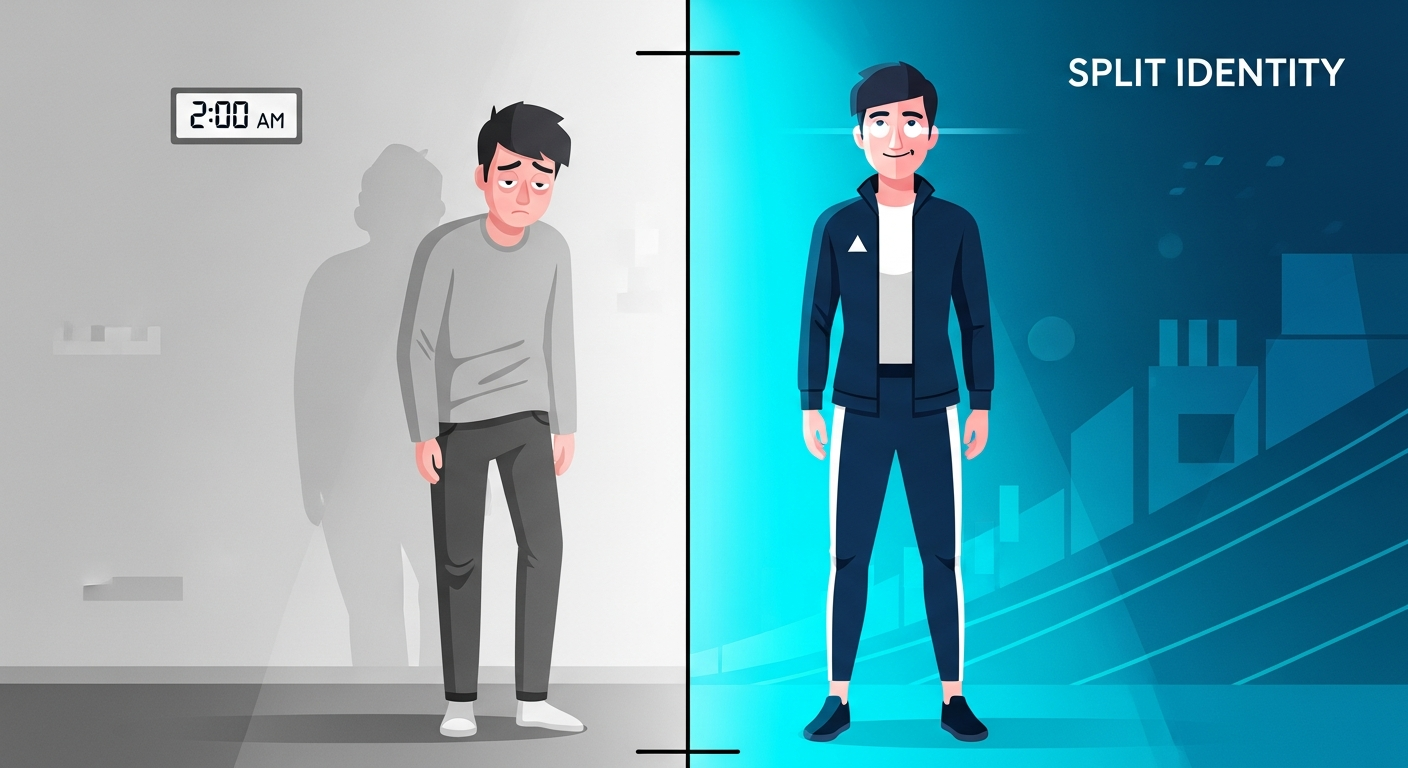
The final stage of discipline is **Integration.** It’s when the "Shadow Why" is replaced by a genuine sense of **Autonomy.** You do the work not because you're terrified, but because it is simply what you do.
You have become the person who does the hard thing, and the "hard thing" has become your new comfort zone.
What’s the One Thing You’re "Quietly" Quitting?
I saw that man at the gym again this morning. He looked tired. He didn't look like a "fitness influencer" having the time of his life.
He looked like a man doing his job. And maybe that's the most "disciplined" thing of all—recognizing that most of the things worth doing aren't fun while you're doing them.
We often talk about the habits we want to *start,* but we rarely talk about the ones we are "quietly" quitting because they’ve become too hard.
We let our focus slip, we let our standards drop, and we tell ourselves we'll "get back to it" when we feel more motivated.
**But motivation is a fair-weather friend, and discipline is the person who stays when the party is over.**
Have you noticed your discipline slipping now that the "New Year" energy has worn off, or is it just me?
I’m curious—what’s the one habit you’re currently fighting yourself on, and what would happen if you stopped "trying" and started "deciding"? Let’s talk about the messy reality of it in the comments.
***
Story Sources
From the Author




Hey friends, thanks heaps for reading this one! 🙏
If it resonated, sparked an idea, or just made you nod along — I'd be genuinely stoked if you'd show some love. A clap on Medium or a like on Substack helps these pieces reach more people (and keeps this little writing habit going).
→ Pythonpom on Medium ← follow, clap, or just browse more!
→ Pominaus on Substack ← like, restack, or subscribe!
Zero pressure, but if you're in a generous mood and fancy buying me a virtual coffee to fuel the next late-night draft ☕, you can do that here: Buy Me a Coffee — your support (big or tiny) means the world.
Appreciate you taking the time. Let's keep chatting about tech, life hacks, and whatever comes next! ❤️