I Found the Secret Epstein-Iran Link. It's Actually Worse Than You Think.
**Riley Park** — Generalist writer. Covers tech culture, trends, and the things everyone's talking about.
I Found the Secret Epstein-Iran Link. It's Actually Worse Than You Think.
I stared at the screen, genuinely baffled. "Epstein-Iran link?" My initial reaction was a slow blink, then a double-take.
It popped up on my feed, then again on a subreddit dedicated to explaining confusing online phenomena.
I first saw it floating around late last year, but by early 2026, the chatter had reached a fever pitch.
A quick search revealed entire threads dedicating serious bandwidth to connecting the infamous Jeffrey Epstein files to, of all things, former President Trump's actions regarding Iran. My gut instinct?
This was either the most mind-bending geopolitical conspiracy theory ever conceived, or it was something else entirely – something far more insidious than a simple false claim.
And as I dug deeper, it became clear: it wasn't the "link" itself that was so disturbing.
It was the terrifyingly efficient *mechanism* by which such an utterly wild, unsubstantiated narrative can seize hold of the collective online consciousness.
The real secret isn’t in the connection between two disparate events, but in the dark alchemy of how we, as digital citizens, construct and consume "truth" in 2026.
And once you see it, you can’t unsee it.
The Uncomfortable Truth About Our Information Diet
Here’s the thing about our brains: they absolutely *despise* a vacuum.
When there's a big, complex, emotionally charged event – say, the slow drip of the Epstein files, revealing names and connections that shock and disturb – we crave an explanation.
We want a neat, coherent narrative. And when the official narratives are slow, incomplete, or feel unsatisfying, our minds are primed to fill the gaps, often with whatever compelling story is on offer.
The online world, particularly platforms like X, TikTok, and the deeper corners of Reddit, has become a hyper-efficient factory for these gap-filling narratives. You see it play out every day.
A major geopolitical event unfolds, like renewed tensions in the Middle East in early 2026, and suddenly, two seemingly unrelated, high-stakes topics become magnetized.
Why? Because the brain, in its relentless pursuit of meaning, looks for patterns. It’s like seeing shapes in clouds; once you’re told it’s a dragon, it’s incredibly hard to see it as just a cloud again.
This isn't just about "gullibility" – it's about fundamental human psychology, amplified by algorithms.
Think about it: 91% of online users admit to encountering misinformation at least once a week, according to a recent study from late 2025.
And while only a fraction of those actively *believe* the most outlandish claims, a much larger percentage are exposed to them, creating a subtle erosion of trust in *all* information.
The problem isn't just the lie; it's the constant, exhausting battle to discern what's real.
The Reframe: It's Not About Believing the Lie, It's About How We Tell Stories
The conventional wisdom is to scoff at these theories, dismiss them as fringe, and move on. But that's missing the point entirely.
To truly understand the "Epstein-Iran link" phenomenon, we have to reframe our perspective.
It’s not about whether a former president's actions regarding Iran were *actually* influenced by the Epstein scandal. That's almost certainly untrue in any direct, provable sense.
The real story is how our digital ecosystems are engineered to turn unrelated anxieties into a single, irresistible narrative.
The problem isn't that people are "stupid" for connecting dots.
The problem is that we’re all operating within a media landscape that incentivizes sensationalism, rewards quick takes over deep analysis, and thrives on outrage.
When you combine the intense public interest in the Epstein files (a story that touches on power, corruption, and moral decay) with the ever-present geopolitical anxieties surrounding Iran (a story of global power, conflict, and uncertainty), you create a potent cocktail.
The "link" isn't a factual connection; it's a *narrative bridge* built from shared anxieties and the human desire for a grand, overarching explanation.
It’s a way to make sense of a world that often feels chaotic and controlled by unseen forces. The more complex reality becomes, the simpler and more dramatic the stories we tell ourselves need to be.
We’re not optimizing for truth; we’re optimizing for narrative coherence, for a story that feels satisfying, even if it’s entirely fabricated.
The "Narrative Contagion" Model: How Wild Theories Go Viral
After wrestling with this specific trend and countless others, I've started to see a pattern.
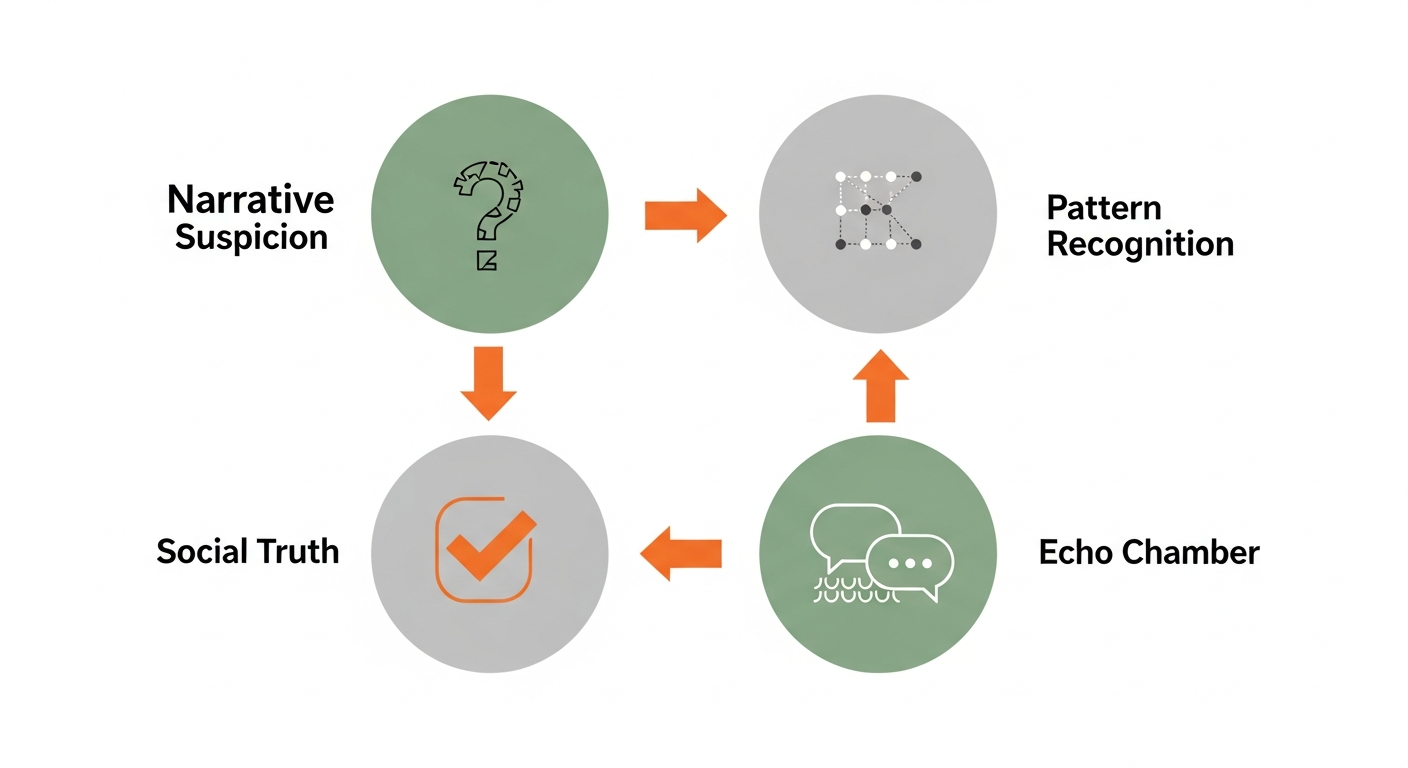
It's a four-stage process, a kind of "Narrative Contagion" model, that explains how seemingly absurd connections don't just emerge, but thrive.
Understanding this framework is key to inoculating ourselves against the spread of future misinformation.
1. The Seed of Suspicion: Fertile Ground for Fear
Every major conspiracy theory needs a starting point, a "seed." This isn't necessarily a lie, but often a genuine event that creates widespread unease, distrust, or a sense of injustice.
The release of the Epstein files, with their implications of powerful people engaging in abhorrent behavior, created exactly this kind of fertile ground.
There was a palpable public hunger for accountability, for answers, and for the feeling that "the truth" was being hidden.

Simultaneously, ongoing geopolitical tensions, like those involving Iran, generate their own unique anxieties.
They tap into fears about global stability, economic impact, and the perceived machinations of world leaders. Each of these events, individually, is a potent source of public concern.
When they coincide, they become raw ingredients for narrative fusion. It's like having two highly flammable materials in the same room, just waiting for a spark.
2. Pattern Recognition (or Misrecognition): Connecting the Dots
This is where our brains, bless their pattern-seeking hearts, kick into overdrive. We are hardwired to find connections, to impose order on chaos.
When two emotionally charged events are present in the public consciousness, our brains instinctively try to link them.
It's often an unconscious process. "If X is happening, and Y is also happening, could X be *causing* Y?"
In the case of the Epstein-Iran link, the "pattern" might be something as vague as "powerful people are corrupt and pulling strings behind the scenes." The Epstein files provide evidence of the first part.
Geopolitical actions, which are often opaque and complex, can then be interpreted as the "strings being pulled." The actual *mechanism* of the link doesn't even need to be clear; the *implication* of a link is enough to satisfy the brain's pattern-seeking urge.
The narrative becomes, "They're trying to distract us from *this* (Epstein) by doing *that* (Iran)." It's simple, dramatic, and gives a sense of knowing something others don't.
3. Echo Chamber Amplification: The Feedback Loop of Belief
Once a nascent narrative bridge is formed, social media acts as an accelerant. Algorithms, designed to keep us engaged, prioritize content that aligns with our existing beliefs and preferences.
If you've previously engaged with content that expresses distrust in government, or interest in high-profile scandals, you're more likely to be shown content pushing the Epstein-Iran connection.

Within these self-reinforcing echo chambers, the narrative gains momentum.
People share it not because they've independently verified it, but because it resonates with their existing worldview, or because it's being shared by people they trust within their network.
Every share, every like, every comment boosts its visibility.
Disagreement is often seen as an attack, further solidifying the group's belief.
The theory isn't just a piece of information; it becomes a badge of identity, a shared secret among the "enlightened." This is how a fringe idea can quickly appear to be a widespread truth.
4. The "Truth" as a Social Construct: Belief Over Fact
Finally, the narrative solidifies, often detaching itself from any need for verifiable facts. In an echo chamber, the "truth" becomes less about empirical evidence and more about social consensus.
If enough people within your trusted circle believe something, it becomes true *for that community*.
Challenging it becomes not just disagreeing with a fact, but challenging the group's identity and loyalty.
This stage is particularly insidious because it weaponizes our natural human need for belonging. To question the "Epstein-Iran link" within a group that fervently believes it might mean ostracization.
So, people often default to silence or even feigned belief, further strengthening the narrative's perceived validity.
By mid-2026, many people who mention this "link" online aren't necessarily asserting a factual connection; they're participating in a shared cultural moment, signaling their alignment with a particular worldview or community.
The narrative becomes a social ritual, a way to express distrust and belonging, rather than a genuine attempt to explain reality.
Navigating the Narrative Minefield: What We Can Actually Do
So, if these narratives are less about direct truth and more about societal anxieties and digital mechanics, what's our move? It's not about becoming a fact-checking vigilante for every single post.
That's exhausting and often counterproductive. Instead, it’s about cultivating a deeper awareness of how these narratives are built and how our own brains are susceptible.
Here are a few "try this today" prompts for navigating the online world in 2026:
* **Pause Before You Share:** Before hitting that retweet or share button on something sensational, especially if it connects disparate, high-stakes events, just take a breath.
Ask yourself: "Does this make me feel outrage? Does it confirm a bias I already hold? Is it designed to provoke a strong emotional reaction?" If the answer is yes, it's a red flag.
* **Identify the "Narrative Bridge":** When you see two unrelated things being linked, consciously try to identify the *underlying anxiety* or *shared assumption* that's creating the connection.
Is it distrust in institutions? Fear of global instability?
A desire for simple answers to complex problems? Understanding the bridge helps you see the construction, not just the destination.
* **Seek Out Disconfirming Evidence (Gently):** Instead of just looking for more information that supports a claim, actively (but gently) seek out perspectives that challenge it.
If a narrative feels too neat, too perfect, or too universally agreed upon within your bubble, it's worth exploring why others might see it differently.
This isn't about arguing; it's about broadening your own understanding.
* **Embrace the Messiness:** Accept that complex issues rarely have simple, dramatic explanations. The world is often messy, ambiguous, and frustratingly devoid of clear-cut villains and heroes.
Cultivating a tolerance for uncertainty is one of the most powerful tools against narrative contagion.
The "Epstein-Iran link" isn't a secret connection waiting to be unearthed by intrepid internet sleuths.
It's a symptom, a digital fever dream born from our collective anxieties and the architecture of our online spaces.
The real "worse than you think" isn't the specific content of the conspiracy, but the terrifyingly efficient way our brains and algorithms conspire to make us believe *anything* that tells a good story.
What's the one online trend you've seen lately that made you pause and wonder how it gained so much traction, even if you didn't believe it? Let's talk about the patterns we're seeing in the comments.
---
Story Sources
From the Author


Hey friends, thanks heaps for reading this one! 🙏
If it resonated, sparked an idea, or just made you nod along — I'd be genuinely stoked if you'd show some love. A clap on Medium or a like on Substack helps these pieces reach more people (and keeps this little writing habit going).
→ Pythonpom on Medium ← follow, clap, or just browse more!
→ Pominaus on Substack ← like, restack, or subscribe!
Zero pressure, but if you're in a generous mood and fancy buying me a virtual coffee to fuel the next late-night draft ☕, you can do that here: Buy Me a Coffee — your support (big or tiny) means the world.
Appreciate you taking the time. Let's keep chatting about tech, life hacks, and whatever comes next! ❤️