I Challenged Firefighters To A Water Fight. I Wasn't Ready For This.

**I challenged the local fire department to a water fight thinking it would be a fun, viral YouTube moment.
I’m currently writing this from my couch, wrapped in three blankets, realizing that everything I thought I knew about "handling pressure" was a complete lie.**
I walked into the station on Tuesday afternoon with a $140 high-capacity pressurized water cannon and enough hubris to fill a tanker truck.
I thought my "agile" movement and "disruptive" tactics would give me an edge over the guys who spend their days polishing "legacy" equipment.
twenty-four hours later, I realized that **the gap between "working hard" and "operating a system" is roughly the difference between a garden hose and a 2.5-inch attack line.**
We talk a lot in the tech world about high-pressure environments, "putting out fires," and scaling under stress.
But after being literally knocked off my feet by a crew that wasn't even breaking a sweat, I realized most of us are just splashing around in puddles. We aren't managed; we're just reactive.
The Hubris of the Super Soaker
My strategy was simple: speed, mobility, and high-frequency bursts. In the world of tech startups and freelance hustling, this is our bread and butter.
We move fast, we "pivot" when things get hot, and we rely on our individual "gear" to save the day.
I had the latest tech in water weaponry, and I assumed that would be enough to compensate for a lack of formal training.
When the horn sounded, I started sprinting. I was firing off bursts, diving behind parked cars, and feeling like a tactical genius.
**I was busy, I was fast, and I was completely ineffective.** I was treating the "conflict" as a series of individual tasks to be completed, rather than a landscape to be controlled.
The firefighters didn't sprint. They didn't even really move that much.
They stayed in a tight formation, connected to a source I hadn't even considered, and waited for me to exhaust my "bandwidth." Within three minutes, my tank was empty, my "agile" legs were tired, and I was standing in the open like a bug waiting for a windshield.
When the Hose Hits the Fan
There is a specific sound a fire hose makes when it’s fully charged—a low, rhythmic thrum that you feel in your teeth.
When they finally opened the nozzle, it wasn't a "fight." It was an environmental shift. The sheer volume of water didn't just hit me; it changed the physics of the space I was standing in.
I realized then that **most of our professional "sprints" are actually just frantic splashing.** We mistake activity for progress because we’re used to measuring success by how tired we are at the end of the day.
The firefighters weren't tired because they weren't fighting the water; they were directing a flow that was already there.
In tech, we often brag about "grinding" through 80-hour weeks to hit a release date. We treat our energy like a Super Soaker—a finite tank we have to manually pump up until our arms hurt.
We eventually run dry, usually right when the "fire" is at its peak, and then we wonder why we’re burnt out and shivering on the sidewalk.
The Infrastructure of Intensity
After the "fight" (which lasted about ninety seconds before I surrendered), I sat down with the Captain, a woman who had been through more real-world "incidents" than I’ve had cups of coffee.
She looked at my high-tech water gun and laughed. "It’s a nice toy," she said, "but you forgot to check your GPM."
GPM stands for Gallons Per Minute. In their world, it’s the only metric that matters.
It doesn't matter how fast you run or how "cool" your nozzle looks; if you aren't delivering enough volume to overcome the British Thermal Units (BTUs) of the fire, you’re just making steam.
**You are either winning the physics of the situation, or you are losing.**
This hit me right in the gut. How many times in my career have I tried to solve a massive, systemic problem with a "small burst" of effort?
We try to fix broken company cultures with a single "all-hands" meeting.
We try to fix "technical debt" with a weekend hackathon. We are bringing Super Soakers to a 4-alarm fire and wondering why the building is still burning.
The Hydrant Protocol: A 3-Step Framework for High-Pressure Living
Sitting in that station, watching them dry their gear with a precision that bordered on the obsessive, I started sketching out what I now call **The Hydrant Protocol.** It’s a mental model for anyone—especially those in high-stress tech roles—who feels like they’re constantly running out of water.

**1. The Static Load (Internal Capacity)**
Before a firefighter ever touches a hose, they know exactly how much "static pressure" is in the system. This is your baseline.
Most of us start our workdays with a "tank" that is already half-empty because of poor sleep, bad boundaries, or "notification fatigue." **If your static load is low, you cannot handle a surge.** You need to treat your baseline capacity as a non-negotiable part of your "infrastructure," not a luxury you'll get to "someday."
**2. Friction Loss (Identifying the Drag)**
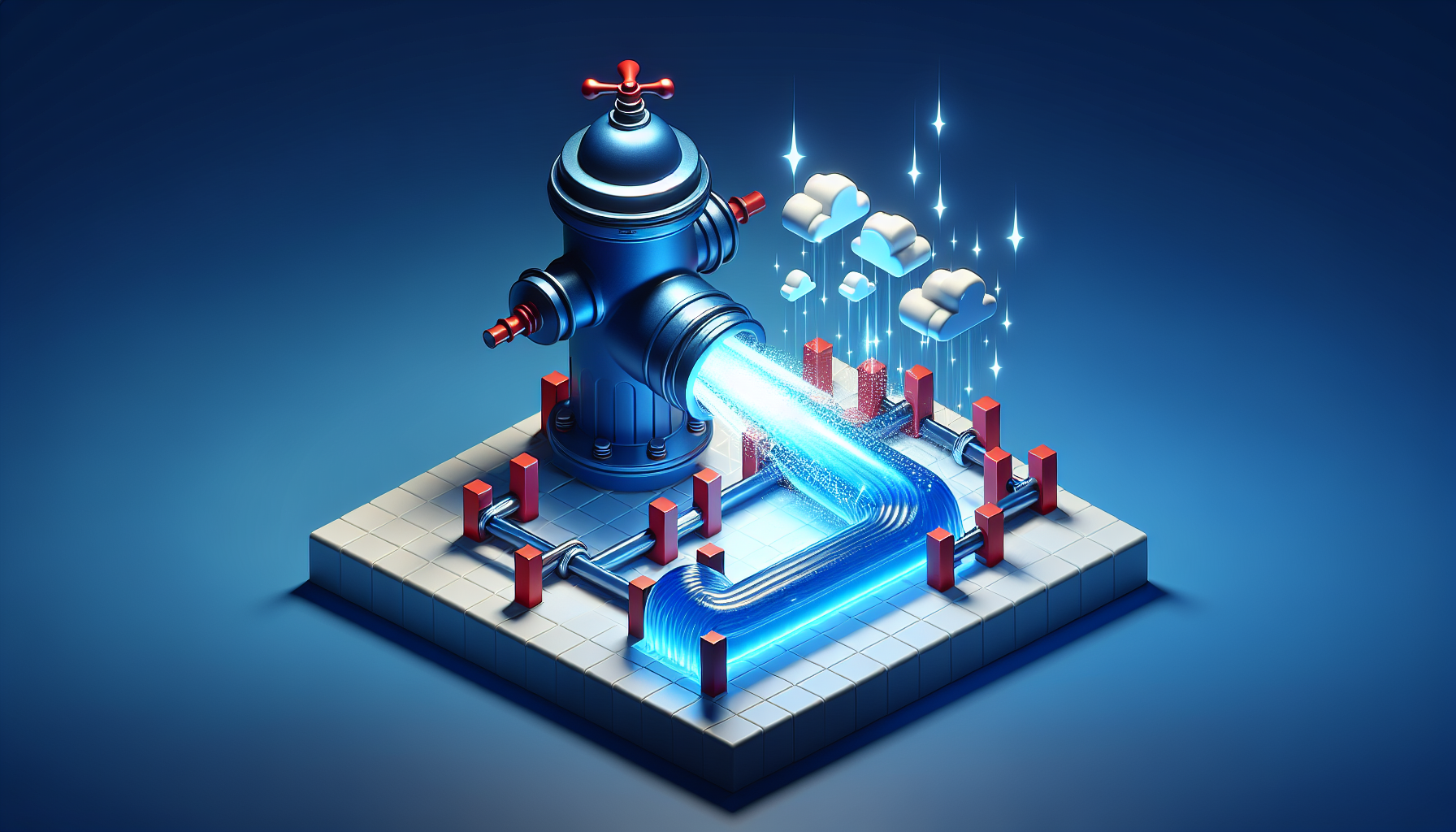
When water moves through a hose, it loses pressure due to "friction loss"—the turbulence created by the walls of the hose itself.
In your professional life, friction loss is the "meeting about the meeting," the poorly defined Jira ticket, and the "quick question" on Slack that derails your flow.
**If your "hose" is 500 feet long and full of kinks, it doesn't matter how powerful the hydrant is.** You have to audit your workflow and remove the turbulence before you try to increase the pressure.
**3. The GPM Mindset vs. The "Drip" Mindset**
The biggest mistake I made in the water fight was trying to be "efficient" with my water. I was taking "targeted shots." The firefighters went for total saturation.
In high-pressure situations, **incrementalism is your enemy.** If a project is failing, don't "tweak" it—flood it with the necessary resources (time, talent, or budget) to overcome the "heat" of the problem instantly.
Doing "just enough" to survive is how you stay in a state of perpetual burnout.
Applying Firefighter Logic to Your 9-to-5
By the time 2027 rolls around, the "hustle culture" we’ve spent the last decade building will likely be seen as a public health crisis.
We are currently 18 months into a shift where "efficiency" is no longer enough to keep up with AI-driven workflows and 24/7 global markets.
We need a new way to operate that doesn't involve us "pumping the handle" until our hearts give out.
The lesson I learned from getting blasted into a rosebush is that **readiness is not a feeling; it’s a system.** Firefighters are calm during a fire because the "thinking" was done months ago during training.
The "pressure" is handled by the mechanical infrastructure of the trucks and the hydrants. They are simply the operators of a very powerful flow.
When you look at your calendar for next week, ask yourself: Am I the operator of a system, or am I just a guy with a plastic gun trying to run between raindrops?
If you feel overwhelmed, it’s rarely because the "fire" is too big—it’s because you’ve disconnected yourself from your "hydrant" and you’re trying to do the work of the system with your own two hands.
The Cost of Being "Agile" Without "Infrastructure"
We love the word "agile." We use it to justify why we don't have long-term plans or why our documentation is non-existent.
But being "agile" in the middle of a disaster is just a fancy way of saying "panicking with style."
**True resilience comes from the Boring Stuff.** It’s the checklists, the redundant systems, and the "boring" maintenance that happens when the sun is out and nothing is burning.
I spent my afternoon trying to be "clever" and "fast," and I got outplayed by people who were "consistent" and "prepared."
I’m still shivering a little bit as I type this, and my "Thunderbolt 3000" is currently in the trash can. I don't need a better water gun. I need a better system.
I need to stop measuring my value by how many "bursts" of energy I can output and start looking at the "infrastructure" of my life.
**What’s the "friction loss" in your current project that’s quietly draining your energy before you even get to the real work? I’d love to hear your thoughts—let’s talk in the comments.**
---
Story Sources
From the Author




Hey friends, thanks heaps for reading this one! 🙏
Appreciate you taking the time. If it resonated, sparked an idea, or just made you nod along — let's keep the conversation going in the comments! ❤️