I Actually Saw Artemis II From 35,000 Feet. Nobody Saw This Coming.

I Actually Saw Artemis II From 35,000 Feet. Nobody Saw This Coming.
**Stop looking at your screen. I’m serious.
While 99% of the passengers on Delta Flight 492 were arguing with Claude 4.6 or scrolling through AI-generated TikToks, I looked out the window and saw something that shouldn't have been possible: four human beings leaving the planet for the first time in over fifty years.**
I wasn't supposed to see it.
The Artemis II launch had been delayed three times this week, and by the time we pushed back from the gate in Orlando, the official NASA stream was still showing a "Hold" pattern.
But as we leveled off at 35,000 feet, heading north toward New York, the pilot’s voice came over the intercom, cracking with a level of excitement you never hear from a seasoned aviator.
"If you look out the right side of the aircraft," he said, his voice dropping an octave, "you’re going to see history."
What happened over the next 120 seconds didn't just change my flight; it rewired how I think about our obsession with the "digital' world versus the "real" one.
We are living through the most significant technological pivot since the industrial revolution, yet we are so bogged down in the minutiae of prompt engineering and LLM benchmarks that we are missing the literal moonshots happening right outside our windows.
The 35,000-Foot Wake-Up Call
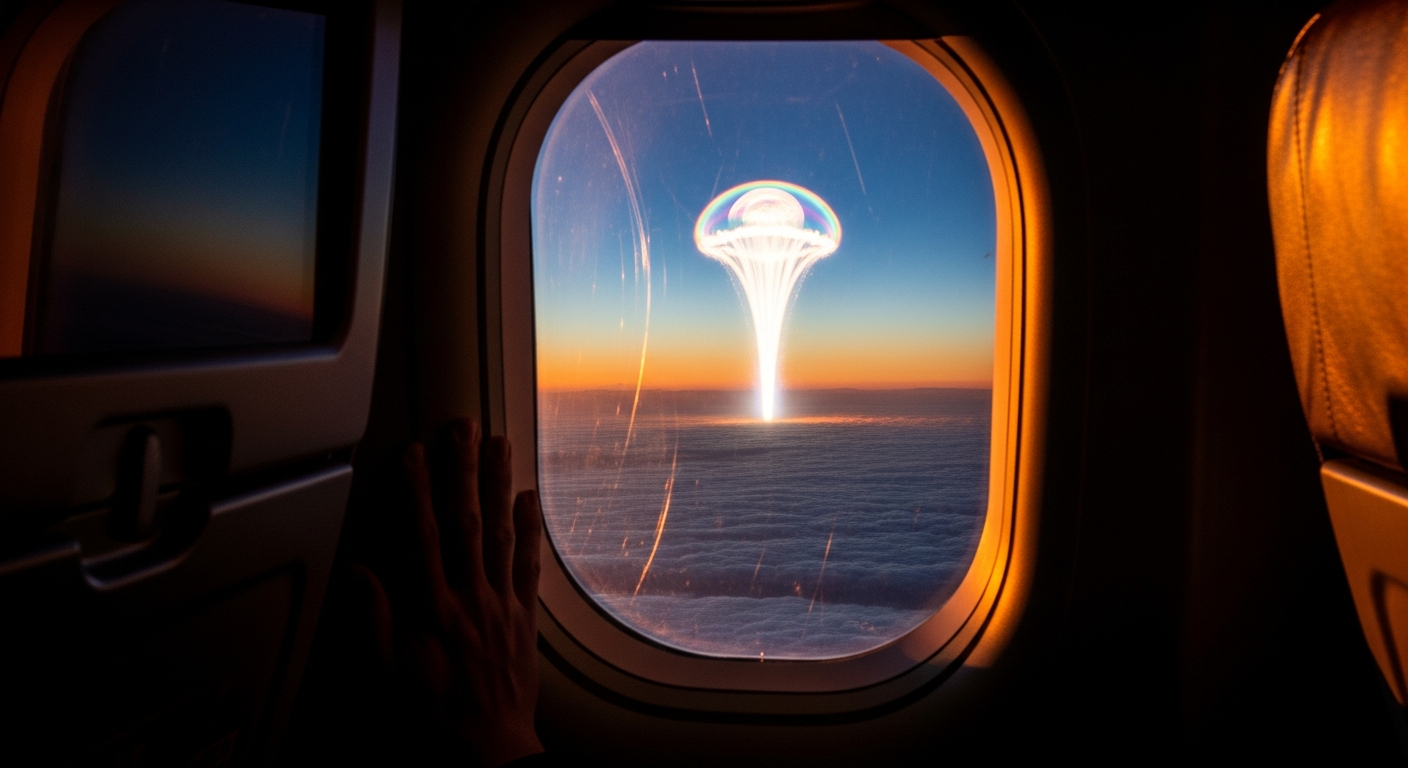
From my seat in 14F, I saw a needle of pure, white light pierce through the Florida haze. It didn't look like a rocket; it looked like a tear in the fabric of the sky.
The plume of the SLS (Space Launch System) expanded as it hit the upper atmosphere, creating a shimmering, iridescent jellyfish of fire that lingered long after the capsule had vanished into the black.
**For a moment, the entire cabin went silent.** No one was complaining about the Wi-Fi speed or the lack of Biscoff cookies.
We were collectively witnessing the "Overview Effect" from a coach-class seat, a visceral reminder that while our screens are getting smaller and more addictive, our potential as a species is still expanding outward.
The irony is that I almost missed it because I was trying to "optimize" my flight time.
I had my noise-canceling headphones on, three browser tabs open, and I was mid-sentence in a prompt trying to get ChatGPT 5 to summarize a 40-page whitepaper on decentralized GPU clusters.
I was "productive," but I was effectively blind.
Why We’re All Suffering From "Low-Ceiling Syndrome"
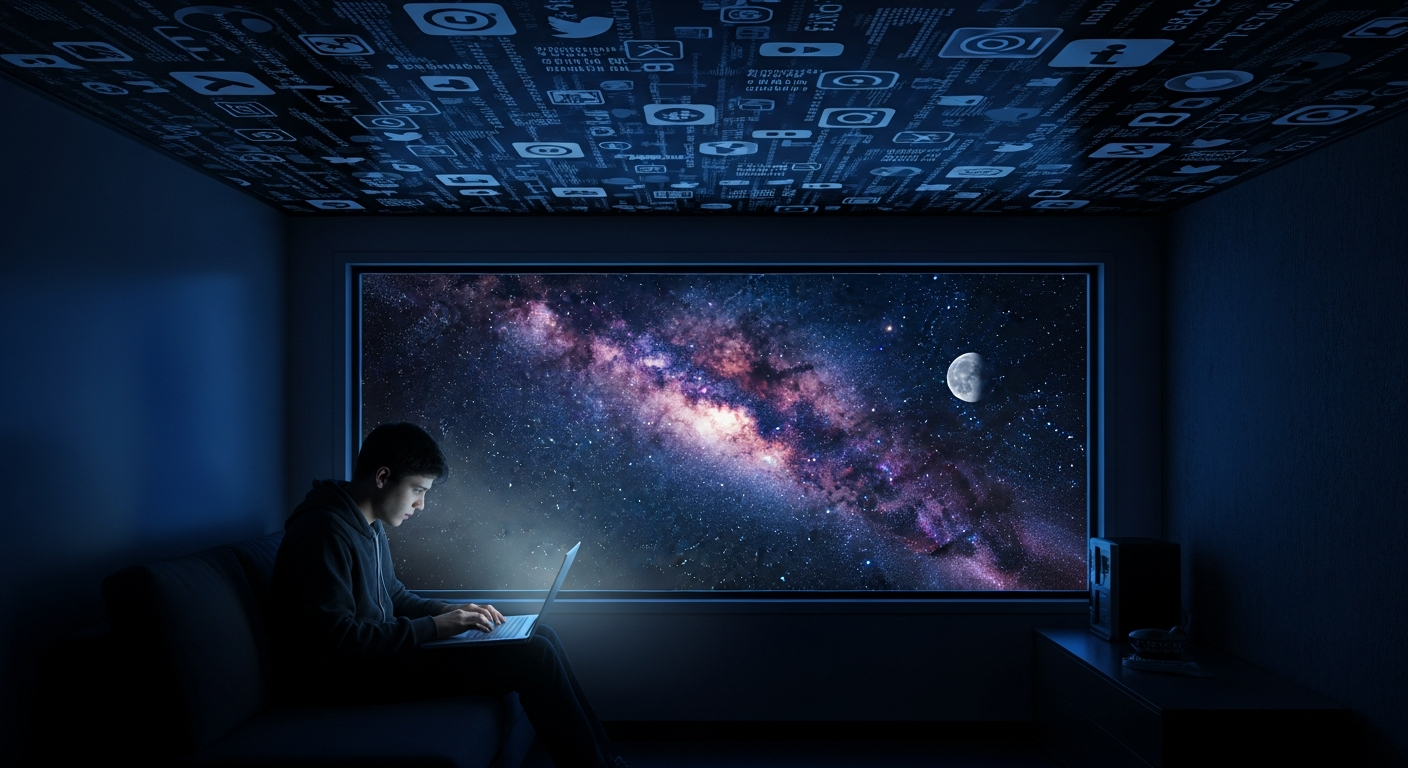
As of April 2026, we have entered what I call the "Low-Ceiling Era." Our technology—specifically our AI—is designed to keep our eyes down.
We are constantly managing "contexts," "tokens," and "outputs." We’ve become curators of the artificial rather than observers of the monumental.
**The data is staggering: the average tech professional now spends 11 hours a day looking at a screen with a focal distance of less than 24 inches.** This isn't just a vision problem; it's a cognitive one.
When your visual world is compressed, your thinking follows suit. We focus on incremental gains, 5% efficiency boosts, and "disrupting" the same three industries over and over again.
We’ve traded the "Moonshot" for the "Mainnet." While Artemis II represents the culmination of a decade of hardware engineering, 90% of the venture capital in 2025 went into software that helps us write emails faster.
We are optimizing our way into a corner, and it’s costing us our sense of wonder.
The Coach-Class Overview Effect
Astronauts often describe the "Overview Effect"—a cognitive shift that happens when you see the Earth from space, realizing how fragile and unified we are.
What I experienced on that flight was a localized version of that. I call it the **Coach-Class Overview Effect.**
It’s the sudden realization that the "emergency" in your inbox is statistically insignificant compared to the physics required to push 8.8 million pounds of thrust into the vacuum of space.
It’s the feeling of being "small" in a way that is actually liberating.
**The problem is that we’ve built a world that is "Overview Proof."** We live in a feedback loop where the algorithm feeds us more of what we already believe, trapping us in a digital ceiling that feels like the entire universe.
If you don't intentionally look up, you’ll never realize how much of the sky you're missing.
The Horizon Protocol: How to Reclaim Your Sense of Scale
After that flight, I realized I needed a system to prevent myself from slipping back into the Low-Ceiling mindset.
I developed the **Horizon Protocol**, a three-part framework designed to help tech-heavy professionals regain their perspective without having to book a flight to Orlando.
Step 1: The Window-Shade Audit
In the tech world, we love "Dark Mode." It’s easy on the eyes, but it’s a metaphor for how we live. The first step of the protocol is a physical audit of your surroundings.
If you are working in a room where you cannot see the horizon, you are operating at a cognitive disadvantage.
**Actionable Step:** Every 90 minutes, you must find a "High-Ceiling" view. This means looking at something at least 100 yards away for a full two minutes.
It resets your nervous system and breaks the "near-work" trance that leads to burnout. If you can’t see the horizon, you aren’t thinking at a horizon-scale.
Step 2: Escape the "Infinite Scroll" Feedback Loop
Our current AI tools (Claude 4.6, Gemini 2.5) are incredibly powerful, but they are "closed systems." They can only give you what has already been digitized.
They cannot give you the "Plume Moment"—the thing that hasn't happened yet.
**Actionable Step:** Implement a "Hardware-Only" hour once a week. Go somewhere where you can see physical engineering at work. A bridge, a construction site, a transit hub.
Remind yourself that the world is built of atoms, not just bits. When you ground your work in physical reality, your software solutions become more practical and less abstract.
Step 3: Practice Temporal Distance
We are obsessed with the "Now." The 24-hour news cycle, the 10-minute deployment, the instant response. Artemis II is a project that took years of slow, methodical, often boring work.
To achieve something great, you have to be willing to work on a timescale that the "Now" culture finds offensive.
**Actionable Step:** Start a "Moonshot File." This is a project or an idea that you know will take at least 18 months to see fruit. No "quick wins" allowed.
By forcing yourself to think in "Years" (like the Artemis team) rather than "Sprints," you escape the low-ceiling of immediate gratification.
From Prompt Engineering to Real Engineering
The most vocal critics of the Artemis program often point to the cost. "Why spend billions on the moon when we have problems here?" they ask.
But seeing that launch from 35,000 feet provided the answer: because we need the "Outward" to solve the "Inward."
**When we stop aiming for the moon, we start fighting over the dirt.** The technology that got those four astronauts into orbit today will eventually trickle down into the sensors in your phone and the medical devices in your hospital.
But more importantly, it provides a unifying narrative that AI—no matter how "intelligent" it becomes—can never provide on its own.
AI is a tool for efficiency; Artemis is a mission for meaning. We need both.
But if we keep prioritizing the tool over the mission, we’re going to end up with a very efficient, very bored civilization that can write perfect poetry about a moon it’s never bothered to visit.
Reclaiming the Wonder of 2026
As we descended into LaGuardia, the sky was turning a deep, bruised purple. The plume was gone, but the energy in the plane hadn't faded. People were actually talking to each other.
"Did you see it?" "I can't believe we were right there."
I closed my laptop and didn't open it again until I was home. The summary of that whitepaper didn't matter. The decentralized GPU clusters could wait.
For the first time in months, I felt like I was living in the *future* rather than just managing a digital present.
**We are living in an age of miracles, but we’ve become miracle-numb.** We have the world's knowledge in our pockets and the stars within our reach, yet we spend our time complaining about the color of a UI button.
It’s time to break the Low-Ceiling Syndrome.
Look up. There is a rocket in the sky, a new version of the world is being built every day, and most of it isn't happening on your screen.
Don't be the person who missed the moonshot because they were busy prompt-engineering a "cleaner" version of a boring life.
---
**Have you ever had a moment where the "real world" suddenly made your digital problems feel tiny?
Or are we so far gone into the AI-sauce that we’ve lost the ability to be impressed by hardware anymore?
Let’s talk about it in the comments — I’m curious to hear if I’m the only one feeling this "Low-Ceiling" burnout.**
---
Story Sources
From the Author




Hey friends, thanks heaps for reading this one! 🙏
If it resonated, sparked an idea, or just made you nod along — I'd be genuinely stoked if you'd show some love. A clap on Medium or a like on Substack helps these pieces reach more people (and keeps this little writing habit going).
→ Pythonpom on Medium ← follow, clap, or just browse more!
→ Pominaus on Substack ← like, restack, or subscribe!
Zero pressure, but if you're in a generous mood and fancy buying me a virtual coffee to fuel the next late-night draft ☕, you can do that here: Buy Me a Coffee — your support (big or tiny) means the world.
Appreciate you taking the time. Let's keep chatting about tech, life hacks, and whatever comes next! ❤️