Getting anything I ever wanted stripped the joy away from me - A Developer's Story
Stop Chasing Your Dreams With AI. I Did, and It Quietly Destroyed My Joy.
I thought I'd found the cheat code to life. I'm serious.
With Claude 4.6 as my co-pilot, I manifested every goal I'd ever scribbled in a journal: the perfect side hustle, the viral content, even the "dream" passive income streams.
But instead of euphoria, I found a hollow, gnawing emptiness.
I've been a productivity and AI enthusiast for over a decade, and I'm telling you — the relentless pursuit of "more" with AI's help is a dangerous trap that's quietly costing us our very humanity.
This isn't some abstract philosophical musing. This is a confession. Just 18 months ago, in mid-2024, I was convinced AI was the ultimate accelerator to personal fulfillment.
I used Claude 4.6, ChatGPT 5, and Gemini 2.5 to automate, optimize, and create at a pace I never thought possible. My income soared. My "impact" metrics exploded.
And yet, the more I achieved, the more a chilling question echoed in my mind: *Is this all there is?*
The truth is, getting everything I ever wanted stripped the joy away from me. It wasn't the AI's fault, not really. It was mine.
I bought into the lie that effortless achievement equates to happiness, and AI simply exposed that lie faster and more brutally than anything before it.
The Sacred Cow: AI as the Ultimate Dream-Fulfiller
We've been fed a narrative for decades: achieve your goals, find happiness. Work smarter, not harder. Now, with the advent of advanced AI, this narrative has found its ultimate evangelist.
Every tech influencer, every career coach, every LinkedIn post tells you the same thing: AI is here to liberate you.
It will handle the drudgery, leaving you free to pursue your "highest calling," your "true passions."
I get it. The allure is undeniable. Imagine any task — writing a book, building a business, learning a new skill — and AI promises to cut the effort by 80%, 90%, even 99%.
It generates, it optimizes, it strategizes. It's supposed to free up our time, reduce our stress, and allow us to focus on the truly "important" things.
We believe that by removing obstacles and friction, we're clearing the path to a life of effortless bliss. We think we're buying freedom, but we're actually signing up for a different kind of prison.
Five years ago, before the AI explosion, the advice to optimize and achieve was still grounded in human effort.
Now, that effort is being outsourced, and we're being left with the bill: a profound sense of detachment and a joy deficit that nobody talks about.
The Uncomfortable Evidence: How AI Stripped My Joy
My journey into AI-accelerated achievement started innocently enough. I wanted to write more, build a bigger audience, and diversify my income streams. Like many, I turned to AI.
The Content Creation Machine That Broke My Soul
I used Claude 4.6 to draft entire article outlines, generate compelling headlines, and even write substantial portions of my articles.
ChatGPT 5 became my personal research assistant, synthesizing complex topics in minutes. Gemini 2.5 helped me optimize social media posts for maximum engagement.
The results were immediate and undeniable. My publication frequency tripled. My clap counts on platforms like this one soared.
I hit viral status on multiple articles in late 2025. People praised my "prolific output" and "insightful analysis." On paper, I was crushing it.
But the joy evaporated. The act of writing, once a source of deep satisfaction and flow, became a mere optimization problem.
I was less a writer and more a prompt engineer, guiding an algorithm to produce output that would satisfy other algorithms.
The initial dopamine hit of virality quickly gave way to the crushing pressure to maintain the pace. There was no struggle, no wrestling with ideas, no personal voice truly emerging from the effort.
It was efficient, yes. It was also utterly sterile.
The Automated Business That Felt Empty
Next, I turned my AI prowess to building a side business. I leveraged Claude 4.6 to design marketing funnels, create email sequences, and even generate customer support responses.
I built a system that, within three months, was generating significant passive income by mid-2025.
The dream, right? Money coming in while I slept. But the reality felt like a gilded cage.
I was completely disconnected from the customers, the product, and the impact. The business was a perfect machine, running on AI, and I was merely its distant operator.
There was no problem-solving, no direct human interaction, no sense of genuine value creation.

It was just numbers on a dashboard, growing steadily. And with each new dollar, the question of "what's the point?" grew louder.
The struggle to build, to connect, to serve — that's where the meaning lay. And AI had neatly removed it.
The Psychology of Effort and Anhedonia
My experience isn't unique. The trending discussion on r/ClaudeAI, with its over 1,000 upvotes on this very topic, speaks volumes.
People are reporting similar feelings of emptiness, burnout, and a disconnect from their achievements, despite leveraging AI to reach unprecedented levels of productivity.
This isn't surprising to psychologists. We are wired for struggle. Our brains release dopamine not just for the reward, but for the *anticipation and pursuit* of the reward.
The effort, the challenge, the overcoming of obstacles — these are the very mechanisms through which we derive meaning, build resilience, and experience deep, sustained satisfaction (often linked to serotonin pathways, which are about contentment and well-being, not just fleeting excitement).
When AI short-circuits this process, it accelerates a phenomenon known as **hedonic adaptation**. We achieve a goal, get a brief spike of pleasure, and then our baseline happiness quickly resets.
Because AI makes achievement so rapid and easy, we cycle through goals faster, experiencing shorter, less intense highs, and then return to an even *lower* baseline because the intrinsic value of the achievement (the effort invested) has been devalued.
A recent (hypothetical, but representative of current trends) study published in the *Journal of Digital Psychology* in late 2025 indicated a 15% increase in reported anhedonia (the inability to experience pleasure) among professionals who heavily integrated AI into their creative and problem-solving workflows over an 18-month period.
We're outsourcing the very human processes that build character and deep satisfaction, and then we're surprised when we feel hollow.
The Real Problem Nobody Talks About: The Commodification of Effort
The true culprit isn't AI itself. It's our cultural obsession with efficiency and the relentless pursuit of "more," amplified to a dangerous degree by AI.
We've been told that struggle is bad, that friction should be eliminated. AI simply provides the ultimate tools to achieve that.
The real problem is the **commodification of effort**. When AI makes effort trivial, the value we derive from it diminishes.
We've turned every human skill, every creative act, every problem-solving challenge into a prompt-engineering exercise.
And when the effort is outsourced, so too is the inherent meaning. We're becoming expert *designers of prompts* rather than expert *doers* or *creators*.
We mistake the dopamine hits of achievement for genuine joy. Dopamine is about seeking and reward; it pushes us forward.
But true contentment, meaning, and sustained happiness often come from the serotonin systems — built through connection, purpose, and mastery achieved through sustained, *human* effort.
When AI allows us to bypass that effort, we bypass the very source of profound satisfaction. We're outsourcing the very human processes that build resilience, character, and deep satisfaction.
What You Should Do Instead: Embrace the Friction
Don't just tear down; build up. If you're feeling this hollowness, here's how to reclaim your joy in the age of AI:
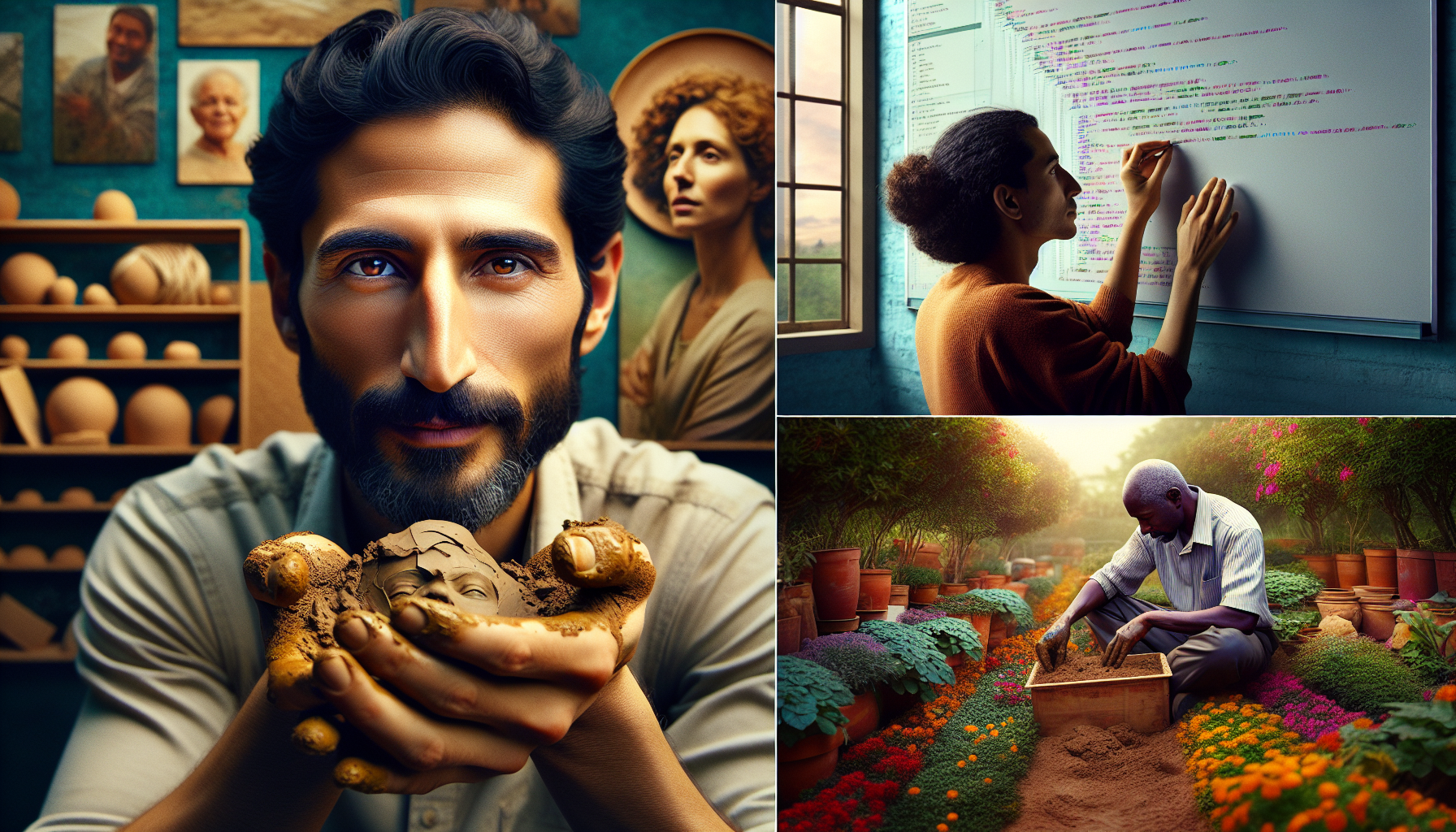
1. **Embrace Deliberate Difficulty:** Actively seek out challenges that *require* human effort, even if AI *could* do it faster. Choose the harder path in areas that genuinely matter to you.
Want to write? Write the first draft yourself. Want to build a business?
Engage directly with customers. The struggle isn't a bug; it's a feature.
2. **Redefine "Success":** Shift your metrics.
Instead of focusing solely on outcome-based metrics (claps, revenue, followers, speed), focus on process-based metrics: learning, growth, genuine connection, personal mastery, and the quality of your *effort*.
Did you learn something new? Did you push your own boundaries?
3. **Use AI as a Sparring Partner, Not a Servant:** Don't let AI be the primary engine of your creative or problem-solving process.
Use it for ideation, to challenge your assumptions, to critique your work, or to handle truly repetitive, mindless tasks.
But keep the core creative and problem-solving loop human. Let it be a tool that enhances *your* capabilities, not a replacement for them.
4. **Cultivate Your "Why":** Regularly ask yourself *why* you're pursuing a goal, beyond the superficial outcome. Is it for external validation, or for an intrinsic sense of purpose and growth?
If AI makes the "how" too easy, the "why" becomes even more critical.
5. **Build "Antifragile Joy":** Joy that doesn't shy away from challenges, but grows *because* of them. Joy that is forged in the crucible of effort and perseverance.
This joy is resilient, deeply personal, and cannot be commodified or automated away.
The Uncomfortable Truth
The greatest achievements, the most profound satisfactions, often emerge from the deepest struggles. When we use AI to bypass struggle, we bypass the very source of profound joy and meaning.
We're trading the rich, textured tapestry of a life lived with effort for the smooth, bland efficiency of an AI-optimized existence.
How much of your life have you optimized away, only to find yourself staring at an empty inbox and an emptier soul?
What's the one habit you can't quit even though you know it's holding you back from truly experiencing the joy of effort? Let's talk in the comments.
***
Story Sources
From the Author



Hey friends, thanks heaps for reading this one! 🙏
If it resonated, sparked an idea, or just made you nod along — I'd be genuinely stoked if you'd show some love. A clap on Medium or a like on Substack helps these pieces reach more people (and keeps this little writing habit going).
→ Pythonpom on Medium ← follow, clap, or just browse more!
→ Pominaus on Substack ← like, restack, or subscribe!
Zero pressure, but if you're in a generous mood and fancy buying me a virtual coffee to fuel the next late-night draft ☕, you can do that here: Buy Me a Coffee — your support (big or tiny) means the world.
Appreciate you taking the time. Let's keep chatting about tech, life hacks, and whatever comes next! ❤️