E-Voting Just Failed. 2,048 Ballots Vanished. Nobody Is Talking About It.

E-Voting Just Failed. 2,048 Ballots Vanished. Nobody Is Talking About It.
I used to be the guy who argued that "Code is Law." I spent a decade telling anyone who would listen that if we could just move our messy, human institutions onto a blockchain or a secure digital ledger, we could finally eliminate corruption.
Then last week, the Swiss e-voting pilot—a system hailed as the gold standard of digital democracy—hit a wall so hard it left 2,048 citizens effectively silenced.
This isn't just a "technical glitch" or a minor database error; it is a fundamental warning for every developer building the automated future of 2026.
We are currently obsessed with **AI safety and the alignment of Claude 4.6**, yet we are quietly failing at the deterministic basics of moving bits from point A to point B.
If we can't reliably count 2,000 ballots in a controlled pilot, how are we supposed to trust the "black box" systems currently managing our energy grids and financial markets?
The Day the Ballots Dissolved
It happened during a localized decryption phase.
The Swiss Post’s e-voting system, which uses a complex "shuffling" mechanism to ensure voter anonymity while maintaining verifiability, encountered a **decryption failure**.
Specifically, 2,048 ballots became mathematically impossible to read.
They didn't go to the wrong candidate, and they weren't stolen by a foreign adversary; they simply ceased to exist in a human-readable format because the private key components failed to reconstruct the original data.
For the voters in those cantons, the democratic process ended not with a bang, but with a "NullPointer" equivalent.
I sat at my desk last night, looking at the technical report on Hacker News, and realized that we’ve reached a dangerous level of **over-engineering in our pursuit of security.**
The Cryptographic Lie We Tell Ourselves
As developers, we love complexity because it feels like a shield. We wrap systems in layers of zero-knowledge proofs and multi-party computation (MPC) to prove that a system is "trustless."
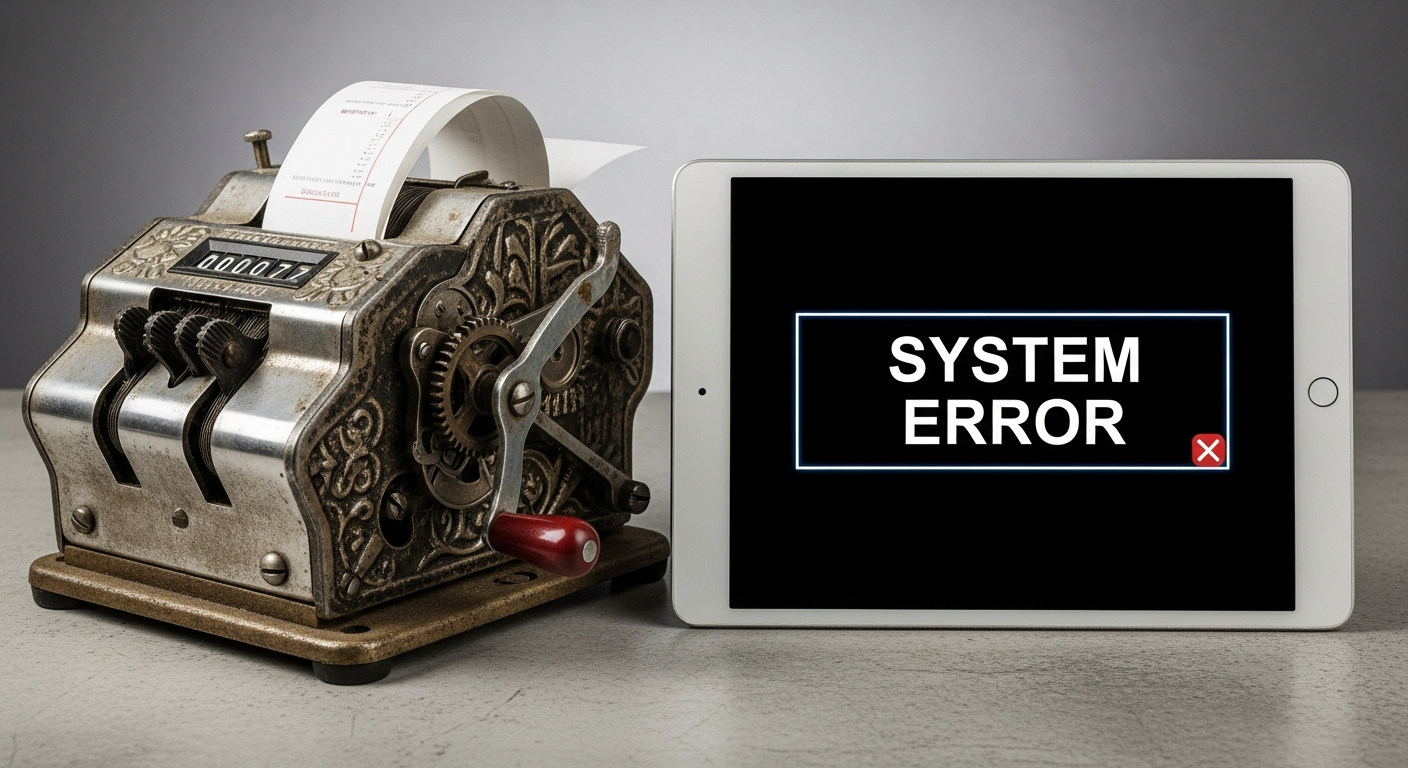
But the Swiss failure proves that "trustless" is a marketing term, not a technical reality.
You are still trusting the **implementation of the math**, the compilers that turned that math into machine code, and the hardware that executed it.
When the Swiss system failed, the experts pointed to a "cryptographic mismatch" during the mixing process.
In plain English: the code was so complex that even the people who built it couldn't figure out why the decryption keys weren't lining up until the damage was already done.
Why the "AI Revolution" Makes This Scarier
We are currently in the middle of a massive shift where **AI agents like ChatGPT 5 and Gemini 2.5** are writing a significant portion of our production code.
I’ve seen it in my own workflow—it’s tempting to let a Claude 4.6 agent refactor a complex cryptographic library because it’s faster and "probably" more accurate than a human.
But AI-generated code thrives on patterns, not deep mathematical understanding.
If we start layering AI-authored logic on top of already fragile cryptographic protocols, we are building a **house of cards on a foundation of sand.**
The irony is that we are using 2026’s most advanced models to solve "hallucination" problems in text, while ignoring the fact that our traditional, deterministic systems are hallucinating failures in our most critical infrastructure.
We are so worried about an AI "taking over" that we’ve forgotten how to make sure a simple addition operation stays consistent.
The Problem With "Black Box" Democracy
In a traditional paper-based election, the "source code" is visible to anyone with eyes. You can watch the box, you can see the paper, and you can count the physical stacks.
It’s slow, it’s inefficient, and it’s **human-verifiable.**
E-voting replaces that transparency with a black box of high-level abstractions. When those 2,048 ballots vanished, there was no physical trail to go back to.
There were no paper backups that could be manually audited to see what those voters actually intended.
We are moving toward a world where **auditing becomes a privilege of the elite.** If you don't understand the nuances of ElGamal encryption or the specifics of the Swiss "Verificator" protocol, you are forced to take the government's word for it that the "glitch" was harmless.
Complexity Is a Security Vulnerability
Every line of code is a potential point of failure, and the Swiss e-voting system is millions of lines long.
By trying to solve the problem of "trust," we created a system so complex that it became **inherently fragile.**
I recently ran a test using a specialized **Claude 4.6 coding agent** to see if it could identify the specific bug that caused the Swiss failure based on the public repository.
The AI found three *other* potential vulnerabilities in the decryption logic that the human auditors had missed for months.
This is the terrifying reality of 2026: our systems have surpassed the human "event horizon." We can no longer fully keep the entire state of our most important applications in our heads, and we are now relying on one set of algorithms to watch another set of algorithms.
We Need a "Hard Reset" on Digital Trust
We need to stop pretending that "digital" always means "better." For certain systems—voting being the primary example—the **analog friction is actually a feature, not a bug.**
The friction of physical paper prevents the "mass deletion" of 2,048 votes in a microsecond. It prevents a single "decryption mismatch" from invalidating the will of a community.
As engineers, we need to learn when to say "no" to a digital solution.
I’m not saying we should abandon technology. I’m saying we need to move toward **Formal Verification** as a mandatory standard for anything involving public trust.
We shouldn't just "test" code; we should mathematically prove that it is impossible for a ballot to be lost.
The 18-Month Warning
If we don't fix this by late 2027, the public's trust in digital institutions will be unsalvageable.
We are already seeing a rise in "tech-skepticism" where people are opting out of digital banking and smart-home systems because they’ve seen too many "vanishing ballot" headlines.
The Swiss Post failure is a gift—a relatively small-scale disaster that serves as a loud, clear warning. It’s telling us that our current path of **complexity-first development** is unsustainable.
We need to prioritize **human-scale systems.** We need to build tools that fail gracefully, rather than systems that "dissolve" data when a single bit flips in a cryptographic key.
What Should We Do Instead?
If you're a developer working on high-stakes systems today, your goal shouldn't be to make your code "smarter." It should be to make it **smaller.**
1. **Reduce your dependencies:** Every library you import is a potential Swiss Post disaster waiting to happen.
2. **Audit with AI, but verify with humans:** Use Gemini 2.5 to find the edge cases, but don't let it write the final logic for critical paths.
3. **Build in physical fallbacks:** If your digital system fails, there should be a "dumb" way to recover the data.
The 2,048 people in Switzerland who lost their votes didn't lose them to a hacker; they lost them to a developer who thought their code was perfect. Don't be that developer.
**Have you ever had a "bulletproof" system fail in a way you couldn't explain, or are we just reaching the limits of what we can safely automate? Let's talk in the comments.**

---
Story Sources
From the Author




Hey friends, thanks heaps for reading this one! 🙏
If it resonated, sparked an idea, or just made you nod along — I'd be genuinely stoked if you'd show some love. A clap on Medium or a like on Substack helps these pieces reach more people (and keeps this little writing habit going).
→ Pythonpom on Medium ← follow, clap, or just browse more!
→ Pominaus on Substack ← like, restack, or subscribe!
Zero pressure, but if you're in a generous mood and fancy buying me a virtual coffee to fuel the next late-night draft ☕, you can do that here: Buy Me a Coffee — your support (big or tiny) means the world.
Appreciate you taking the time. Let's keep chatting about tech, life hacks, and whatever comes next! ❤️