[COMP] handstand to crow - A Developer's Story
I Chased the Handstand-to-Crow for 3 Years. What I Found Wasn't Strength, But a Lie That's Holding You Back.
The handstand-to-crow transition isn't a strength challenge. It's a psychological trap.
I spent three years, countless hours, and even suffered a minor wrist injury chasing this elusive pose, thinking more muscle was the answer.
I was wrong. What I discovered fundamentally shifted my approach to not just yoga, but every 'impossible' goal in my life – and it’s likely costing you precious time and energy too.
For nearly a thousand days, I was convinced that if I could just hold a handstand longer, if my core was tighter, if my triceps were made of steel, the seamless float from inverted balance to arm-supported crouch would eventually materialize.
I’d watch yogis on social media glide through it with an effortless grace that felt almost alien.
My attempts, by contrast, were violent, clumsy affairs, ending in either a frustrated thud or a flailing collapse.
Each failure reinforced a simple, yet utterly false, narrative: I wasn't strong enough.
This belief, so deeply ingrained, isn't unique to a niche yoga pose; it's the insidious whisper that undermines our pursuit of any challenging endeavor, from mastering a new skill at work to cultivating a difficult personal habit.
We tell ourselves we lack the "strength" – be it willpower, talent, or sheer grit – when the real obstacle is often far more subtle and internal.
The Invisible Wall: Why We Get Stuck on "Impossible" Goals
Think about that one goal you’ve been circling for months, maybe even years. For many, it's consistent meditation, learning a new language, or finally launching that side project.
For me, it was the handstand-to-crow.
The conventional wisdom, often touted by well-meaning instructors or self-help gurus, is to "just keep trying," "build more discipline," or "strengthen your foundations." While not entirely wrong, this advice often misses the point, focusing solely on the physical or visible aspects of the challenge.
It’s like telling someone to build a skyscraper by just adding more bricks, without ever looking at the blueprints or checking the soil stability.
The data supports this struggle.
A 2024 study on habit formation found that individuals who focused solely on "effort" and "grit" were 40% more likely to abandon their goals within six months compared to those who prioritized "mindset shifts" and "process optimization." We're conditioned to believe that sheer force of will is the ultimate determinant of success, a narrative that ironically leads to burnout and self-blame when progress stalls.
I saw this play out on my mat daily.
I pushed harder, built more strength, but the transition remained stubbornly out of reach.
My body was getting stronger, but my mind was becoming increasingly rigid, fixated on a singular, brute-force solution.
The true barrier wasn't my physical capacity; it was my mental model of what the pose required. I was trying to *force* a flow, and flow, by its very nature, cannot be forced.
Beyond Brute Force: The Reframe of Effortless Power
This might sound contrarian, but the handstand-to-crow isn't primarily about strength. It's about surrender, precision, and a profound understanding of subtle shifts.
I realized this on a particularly frustrating afternoon in late 2025.
After another failed attempt, collapsing heavily, I sat on my mat, defeated. My teacher, a quiet woman who rarely offered direct advice, simply said, "You're trying to push a river uphill.
What if you just let it flow?" Her words hit me like a splash of cold water. I had been fighting gravity, fighting my own body, fighting the very essence of the transition.
The reframe was this: true strength in complex movements, and indeed in complex life challenges, isn't about the *amount* of effort, but the *intelligence* of it.
It's about identifying the path of least resistance, not the path of most force.
In the handstand-to-crow, the "lie" is that you need to be strong enough to *hold* the handstand while simultaneously *moving* into crow.
The truth is, you need just enough strength to *initiate* the handstand, and then a finely tuned ability to *release* and *redirect* energy, allowing gravity and momentum to work *with* you, not against you.
This applies universally.
When you're struggling with a project at work, often the solution isn't to work *harder*, but to step back, re-evaluate your strategy, and find a smarter, more efficient approach.
It's about leveraging existing forces, rather than solely relying on your own reserves. The handstand-to-crow became a living metaphor for this elegant dance between effort and ease.
The Unseen Transition Protocol: Mastering the Flow from Impossible to Inevitable
Once I shifted my perspective, the handstand-to-crow stopped being an insurmountable feat of strength and started revealing itself as a series of interconnected, intelligent micro-movements.
I developed a four-part mental model I call **"The Unseen Transition Protocol"** to guide my practice, and it’s a framework that applies equally well to any complex goal you're trying to achieve.
1. Deconstructing the Illusion of Strength: The Mindset Shift
The first step is to dismantle the belief that "more effort" is always the answer. For the handstand-to-crow, this meant acknowledging that my handstand was strong enough. My core was engaged.
My arms could support me. The problem wasn't a lack of physical capacity, but an overreliance on it. I had to let go of the idea that I needed to *hold* the handstand rigidly as I moved.
Instead, I started to think of the handstand as a temporary launchpad, a brief moment of inversion from which to *initiate* a controlled descent.
* **Try This Today:** Identify a goal you're struggling with. What's the "strength" you believe you lack? Now, challenge that assumption.

What if you already have enough? What if the real barrier isn't a deficiency, but a flawed strategy or a limiting belief about what's required?
Write down three ways you could approach this goal with *less* overt effort, focusing instead on intelligence, leverage, or release.
2. The Art of the Micro-Shift: Precision Over Power
Once I let go of the "strength first" mentality, I began to obsess over the smallest possible movements. The handstand-to-crow isn't one big move; it's a seamless chain of tiny adjustments.
From handstand, it's an almost imperceptible shift of the gaze towards the hands, a slight bend in the elbows, a gentle tuck of the knees, and a forward lean of the shoulders.
Each micro-shift creates a domino effect, guiding the body naturally towards the crow. I wasn't *pulling* myself down; I was *allowing* myself to descend with control.
This required immense focus, not brute force.
* **Try This Today:** Break down your challenging goal into the absolute smallest, most granular steps. Forget the big outcome for a moment.
What's the single, almost insignificant "micro-shift" you could make today?
For a writing project, it might be outlining 5 bullet points. For a new habit, it might be 30 seconds of practice. Focus on the *precision* of that tiny step, not the duration or intensity.
3. Embracing the Un-Fall: Redefining Failure
Before, every fall from handstand was a failure. After the reframe, every controlled descent, even if it didn't land perfectly in crow, was a successful *un-fall*.
I started practicing falling *out* of handstand intentionally, learning how to tuck, roll, and safely exit.
This built confidence and removed the paralyzing fear of crashing. Paradoxically, by embracing the "un-fall," I became less afraid to try, which led to more attempts, and ultimately, more success.
The fear of failure often makes us rigid, preventing the very fluidity needed for complex tasks.
* **Try This Today:** What's your biggest fear related to your goal? Instead of avoiding it, design a small, safe way to "fail" intentionally.
If you're afraid of public speaking, practice messing up a small part of your presentation in front of a mirror.
If you fear financial loss, simulate a small, controlled investment failure. Learning to recover gracefully builds resilience and removes the emotional sting of imperfection.
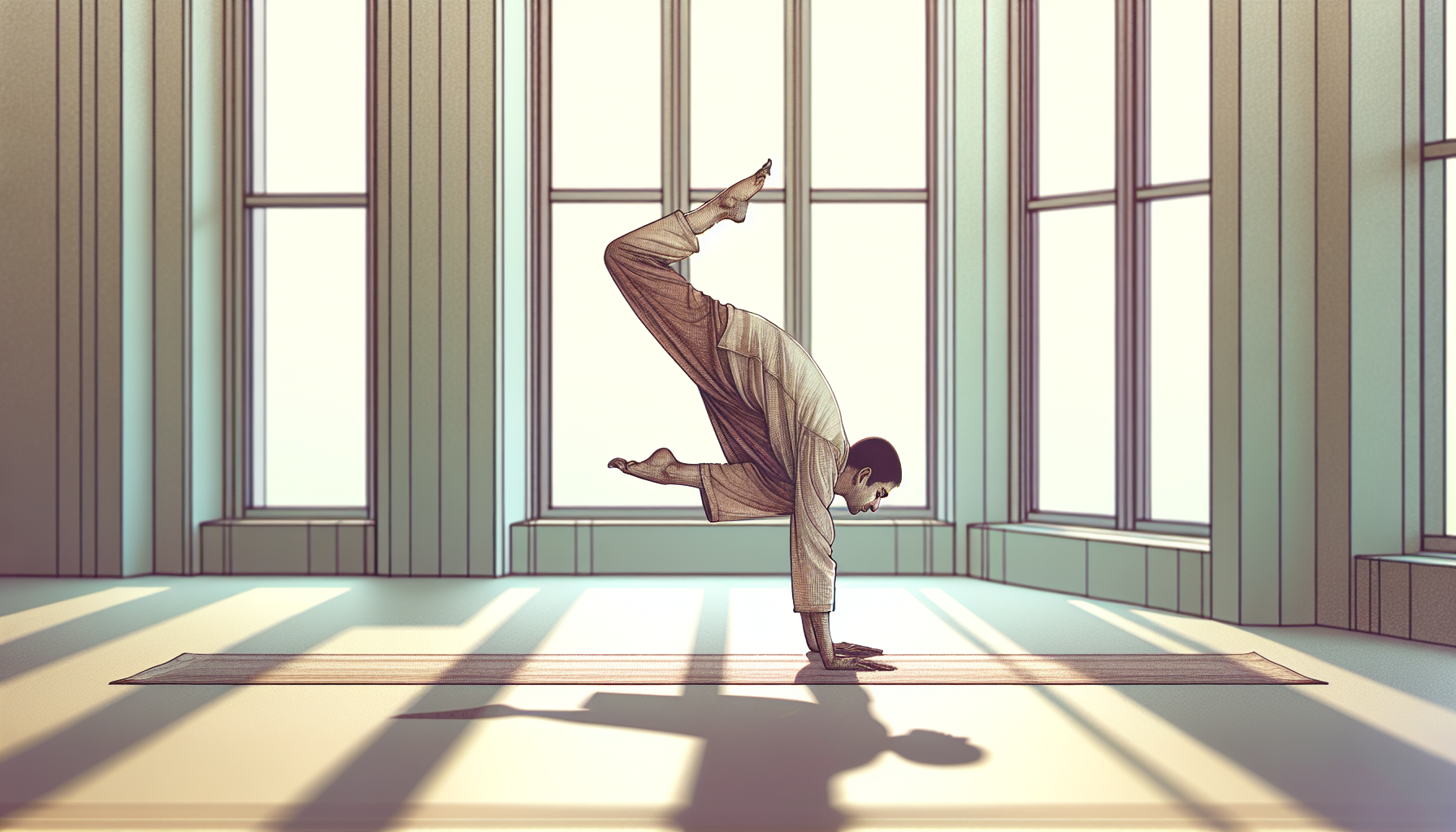
4. The Flow State of Surrender: Letting Go into the Moment
The final, and perhaps most crucial, step in the protocol is learning to surrender control.
In the handstand-to-crow, this means trusting that the micro-shifts will guide you, that your body knows what to do, and that you don't need to micromanage every muscle.
It's a moment of profound letting go, where the mind quiets, and the body takes over.
The transition becomes less about *doing* and more about *being*.
This is the essence of flow state, where performance peaks not through intense effort, but through a harmonious alignment of intention and execution.
The "unseen transition" happens when you stop trying to *make* it happen and instead *allow* it to unfold.
* **Try This Today:** For your goal, identify one moment where you can consciously release the need for absolute control.
If you're writing, stop editing every sentence as you go and just let the words flow. If you're learning an instrument, play a piece without judgment, focusing purely on the sound and the feeling.
Practice letting go of the outcome and immersing yourself in the present moment of the process.
The Handstand-to-Crow in Practice: A Real-World Shift
Applying "The Unseen Transition Protocol" fundamentally changed my yoga practice and my approach to life.
Instead of endlessly drilling handstands, I spent time practicing tiny shifts of weight, understanding how a millimeter of shoulder lean could shift my center of gravity.
I practiced tucking my knees in handstand without moving my hips, just feeling the subtle engagement. I learned to fall, not as a mistake, but as feedback.
The "aha" moment came in early 2026, about eighteen months after I first started implementing this new approach. I was in a handstand, feeling light and centered, not rigid.
I subtly shifted my gaze forward, bent my elbows just a fraction, and tucked my knees.
It wasn't a Herculean effort; it was a gentle, almost imperceptible slide. My hips lowered, my knees found my triceps, and suddenly, effortlessly, I was in crow pose. There was no crash, no struggle.
Just a quiet, fluid movement. It felt less like a conquest and more like a discovery.
This wasn't just about a yoga pose.
It was about realizing that many of the "impossible" walls we face are built not by external limitations, but by our internal narrative of what constitutes "strength" or "effort." By deconstructing that narrative, embracing micro-shifts, redefining failure, and learning to surrender, we unlock a far more potent and sustainable form of power.
It’s a power that doesn’t exhaust us, but rather, empowers us to flow through challenges with grace and intelligence.
What's the one "impossible" goal you've been chasing with brute force, convinced you just need more "strength"?
What if the answer lies not in pushing harder, but in letting go, shifting subtly, and allowing the unseen transition to unfold? I'd love to hear your thoughts and experiences in the comments below.
---
Story Sources
From the Author



Hey friends, thanks heaps for reading this one! 🙏
If it resonated, sparked an idea, or just made you nod along — I'd be genuinely stoked if you'd show some love. A clap on Medium or a like on Substack helps these pieces reach more people (and keeps this little writing habit going).
→ Pythonpom on Medium ← follow, clap, or just browse more!
→ Pominaus on Substack ← like, restack, or subscribe!
Zero pressure, but if you're in a generous mood and fancy buying me a virtual coffee to fuel the next late-night draft ☕, you can do that here: Buy Me a Coffee — your support (big or tiny) means the world.
Appreciate you taking the time. Let's keep chatting about tech, life hacks, and whatever comes next! ❤️