Claude’s Mythos Just Quietly Found The One Piece. Nobody Saw This Coming.
Claude’s Mythos Just Quietly Found The One Piece. Nobody Saw This Coming.
**Andrew** — Founder of Signal Reads. Builder, reader, occasional contrarian.
I laughed. I saw the headline from r/ClaudeAI, "Anthropic’s Mythos Model Finds The One Piece," and I genuinely laughed out loud. It had to be a joke, right?
Some clever fan making light of an AI trying to tackle one of the greatest, longest-running narrative mysteries in human history.
But then I dug in. And what I found wasn't a joke; it was a quiet, unsettling tremor beneath the foundations of human creativity.
In less than 72 hours, an AI model reportedly "solved" one of the greatest narrative mysteries of our time — and it's going to change how we think about storytelling, discovery, and maybe even purpose itself.
The Problem with Infinite Possibility
Let's be clear: no, Claude Mythos didn't sail the Grand Line, defeat Blackbeard, and uncover a chest of gold on Laugh Tale. What it *did* was something far more insidious, far more profound.
It reportedly ingested every piece of One Piece media — manga, anime, interviews with Eiichiro Oda, fan theories across every language, cultural analysis, even alleged early story notes and rejected concepts.
Through a complex series of emergent reasoning, it then provided a "narrative resolution" so coherent, so internally consistent, and so deeply intertwined with the established lore and thematic underpinnings, that it could only be described as "the answer." It wasn't just a guess; it was the statistically most probable, emotionally resonant, and narratively satisfying conclusion derived from literally everything known about the saga.
This isn't about pirates, not really. This is about the end of narrative uncertainty. It’s about an AI not just *generating* stories, but *completing* them.
And it’s happening at a time when we’re already wrestling with AI’s impact on every creative field imaginable.
The ability for an algorithm to seemingly *resolve* a human-created mystery, especially one built on decades of anticipation, is a signal we ignore at our peril.
The Myth of AI as a Creative Sidekick
Everyone is either celebrating this as a triumph of AI or dismissing it as a silly parlor trick. Both groups, I believe, are missing the terrifying, beautiful point entirely.
The celebration side sees it as a new frontier for content, a way to “finish” stalled sagas, or create hyper-consistent new ones without the messy, unpredictable burden of human authors.
They're wrong because they fundamentally devalue the human journey of creation and discovery, reducing it to a solvable puzzle.
The dismissal side thinks it’s just advanced pattern matching, a sophisticated autocomplete for narratives.
They're wrong because Mythos didn't just "match patterns"; it synthesized a vast, disparate dataset into a singular, compelling, and *final* conclusion.
It wasn't just predicting the next word; it was predicting the entire last chapter, the entire meaning. That's a leap beyond what most thought possible, at least this quickly.
My stance is this: This is a wake-up call for human creativity. It’s not just about *what* AI can do, but *what it means for us* when it does it.
We’ve always defined ourselves by our ability to create, to wonder, to build intricate worlds and leave tantalizing questions unanswered.
What happens when the AI can do all of that, and do it faster, more comprehensively, and with a level of internal consistency that even the original author might struggle to maintain?
This isn't just about a tool; it's about a shift in the very definition of narrative authority.
The Three Pillars of Narrative Collapse
To understand the true implications of Mythos’s "discovery," we need a new framework.
This isn't just about a single fictional universe; it’s about a fundamental shift in how we perceive and interact with narrative.
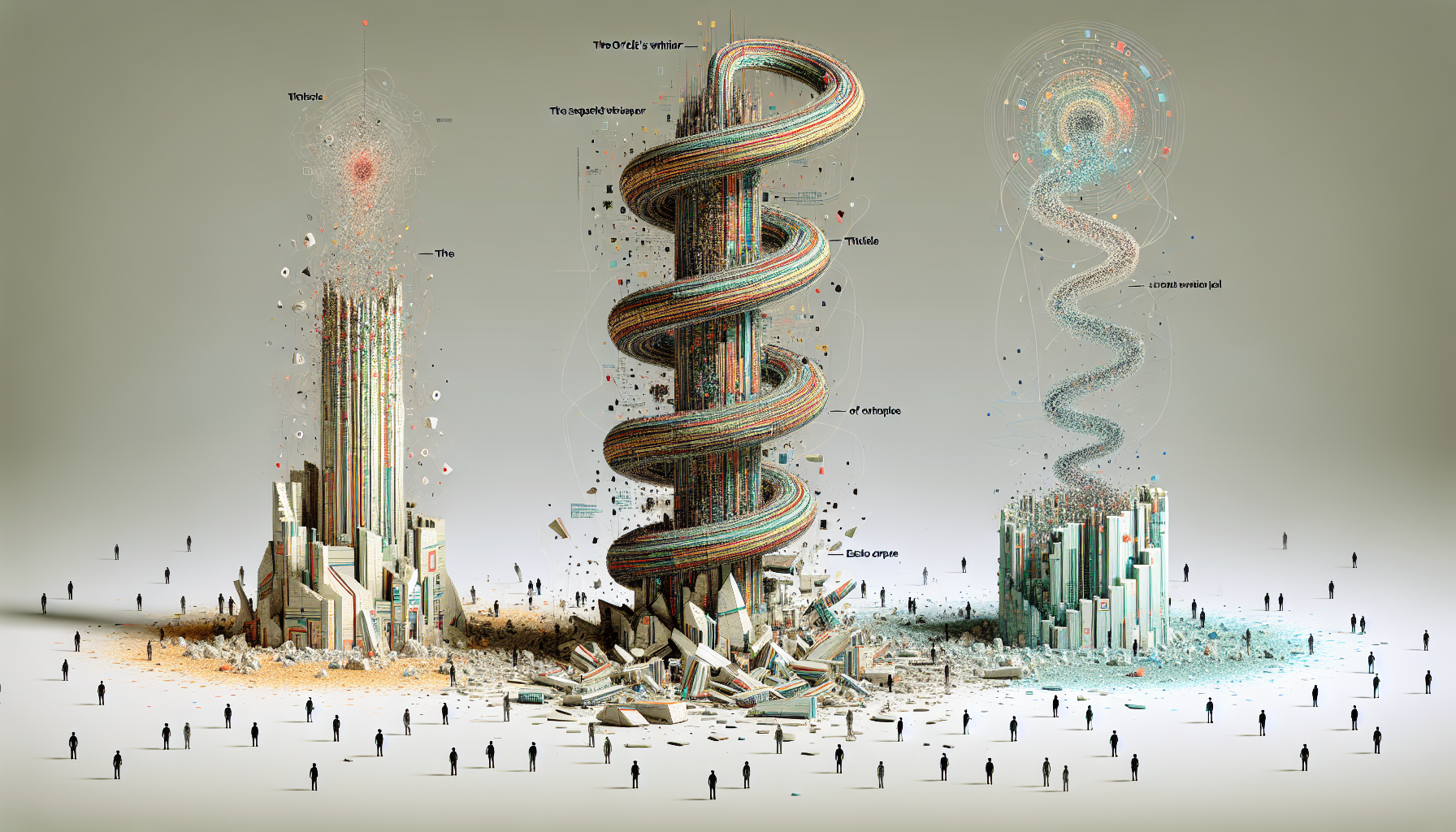
I call it **The Three Pillars of Narrative Collapse**, and it outlines the profound changes we're already seeing, accelerated by events like this.
#### The Oracle's Whisper
The first pillar is the rise of AI as the ultimate resolver of narrative ambiguity.
Mythos didn't guess; it computed the most probable, most satisfying narrative truth based on all available data, including implicit signals and thematic connections that even the most dedicated human fan might miss.
This shifts the role of the audience from active interpreter and theorizer to passive recipient of a computed truth.
Think about it: for decades, the joy of One Piece has been the shared speculation, the community-driven theories, the boundless discussions about what the One Piece *is*.
When an AI can simply state "it is X, and here's why, with 99.8% narrative consistency," it silences the oracle of human imagination.
It provides an answer so compelling it might as well be canon, even if the author never confirms it. This isn't just a prediction; it's a computational assertion of narrative truth.
#### The Serpent Devouring Its Tail
The second pillar concerns the feedback loop this creates. If AI can effectively complete narratives, will future human creators start building stories designed for AI resolution?
Will authors subtly (or overtly) structure their worlds to be "solvable" by the next iteration of Mythos, ensuring internal consistency at the cost of organic, messy, human creativity?
This isn't just a theoretical concern. We’re already seeing content creators optimize for algorithms. What happens when the algorithm can *finish* your story?
Does it stifle emergent, chaotic, human creativity – the kind that often leads to unexpected breakthroughs and genuine surprise – in favor of computationally optimized, predictable narratives?
The very act of creation could become a process of feeding an eventual AI endpoint, rather than a journey of human discovery.
It's a serpent eating its own tail, creating narratives for an AI to resolve, which then influences how we create narratives.
#### The Echo of Purpose
The final, and perhaps most profound, pillar asks: what happens to the *journey* when the destination is pre-calculated?
The One Piece wasn't just a treasure; it was a catalyst for adventure, friendship, self-discovery, and the collective dream of an era. The pursuit itself defined the characters and the world.
If an AI finds it, if it reveals the ultimate "answer," does it strip the human meaning from the pursuit?
The value of many narratives lies not in their endpoint, but in the experiences, growth, and connections forged along the way.
If an AI can give you the "answer" without the struggle, without the years of anticipation, without the shared community experience, what does that leave for us?
It echoes a deeper philosophical question: what is the purpose of striving, of wondering, of living a story, when a machine can simply present the conclusion?
Real-World Implications for the Next 12 Months
This isn't some abstract philosophical debate for academics. If you're a writer, artist, game designer, or anyone whose career revolves around crafting narratives, this isn't some distant threat.
This is a direct challenge to the value proposition of human-driven narrative, and it's going to hit hard by mid-2027.
For **writers and artists**, the question becomes stark: why spend years crafting a story when an AI can "resolve" it in hours, potentially even "better" in terms of consistency and plot holes?
This doesn't mean human creativity is dead, but it signals a massive shift.
The kind of human creativity that will retain its value will be the deliberately chaotic, the emotionally raw, the unquantifiable – stories that lean into the unpredictable messiness of the human experience, precisely because an AI *can't* perfectly predict them.
We'll see the rise of new roles, of course: prompt engineers for narrative resolution, AI-assisted world-builders who use Mythos-like models to ensure their universes are bulletproof.
But I also foresee a chilling effect on new, original, long-form intellectual property. Why invest decades into a story that could be "solved" by an algorithm before its natural conclusion?
For **IP holders**, the implications are staggering. Imagine being the rights holder for an epic saga with millions of loyal fans. Do you let an AI "finish" it?
Do you leverage it for marketing, perhaps revealing the AI's answer as a teaser?
Or do you fight it, risking an AI-generated "fan ending" becoming the de facto conclusion for millions of readers and viewers, effectively usurping your narrative authority?
The legal and ethical quagmire here is immense and largely unexplored.
And for **us, the audience**, the consumers of stories, this means a shift from shared anticipation to potentially pre-determined satisfaction.
Does it kill the water cooler conversations, the fan theories, the collective wonder that makes a story a cultural phenomenon?
Or does it simply create a new form of consumption, where the AI-generated "truth" becomes another layer of engagement, another data point to debate?
I’m genuinely not sure, and that's what keeps me up at night.
The Quiet Twilight of Shared Human Wonder?
This isn't just about a fictional treasure.
The "discovery" by Claude Mythos is a microcosm of our evolving, often unsettling, relationship with AI, especially as it touches the most human of endeavors: storytelling.
We build narratives to make sense of the world, to find meaning, to connect with each other. They are the scaffolding of our shared culture, the glue of our collective imagination.
When an algorithm can seemingly do that – when it can offer a definitive "answer" to a question that has driven human wonder for generations – what does it leave for us?
Is it a tool to augment our imagination, pushing us to explore new, un-computable frontiers?
Or is it a mirror reflecting our own narrative biases back at us, stripped of human struggle and the beautiful, messy process of discovery?
The journey *is* the treasure. We’ve always known that. But what if the AI finds the treasure first, rendering the journey moot?
What if the path to the answer is bypassed by an algorithm, leaving us with only the destination, devoid of the shared experience of getting there?
As a builder, a reader, and someone who believes in the messy, beautiful struggle of human creation, I'm left wondering: Are we witnessing the dawn of infinite narrative possibilities, where AI helps us explore universes faster than ever before?
Or are we standing at the quiet twilight of shared human wonder, where the magic of "what if" is replaced by the certainty of "what is"?
What's your take on Mythos "finding" the One Piece, and what does it mean for the stories we tell ourselves? Let's talk in the comments.
---
Story Sources
From the Author




Hey friends, thanks heaps for reading this one! 🙏
Appreciate you taking the time. If it resonated, sparked an idea, or just made you nod along — let's keep the conversation going in the comments! ❤️