ArXiv Just Quietly Quit Cornell. This Changes Everything.
**Stop trusting "legacy" academic institutions to guard the future of human knowledge.
I’m serious.** Yesterday, ArXiv—the 34-year-old bedrock of open science—quietly declared its total independence from Cornell University.
It is a move that should have happened five years ago, but the fact that it is happening in March 2026 tells you everything you need to know about the "Data Wars" currently tearing the tech world apart.
If you aren't an academic, you might think this is just bureaucratic inside baseball. It isn't.
ArXiv is the "underground" library where almost every major breakthrough in AI, physics, and mathematics has been published for free since the late 1990s.
If ArXiv moves, the very foundation of how we share human intelligence moves with it.
I’ve spent the last three years watching legacy institutions struggle to keep up with the breakneck speed of the LLM era.
**The "Cornell Divorce" isn't just about administrative freedom; it’s a desperate attempt to save open science from being eaten alive by predatory scrapers and centralized AI labs.**
The Ghost in the Machine
For decades, ArXiv lived in the quiet halls of Cornell, surviving on a shoestring budget and a "good enough" web interface that looked like a relic from 1995.
It didn't matter what it looked like because the content was pure gold.
Every revolutionary paper, from the original "Attention Is All You Need" to the first benchmarks for **Claude 4.6**, landed there first.
But over the last 18 months, the burden of hosting the world’s most valuable data became a liability.
Cornell’s servers were being hammered by thousands of bots every second, all trying to ingest the latest research to train **ChatGPT 5** and other frontier models.
The university’s legal department, bound by a century of "slow-and-steady" policy, simply couldn't move fast enough to protect the researchers.
I remember talking to a PhD candidate last year who couldn't even upload her thesis because the site was essentially under a perpetual DDoS attack from "research" scrapers.
**The system was breaking because it was too valuable to remain free under the old rules.** LANL was a wonderful steward for the 20th century, but in 2026, ArXiv needed to become a sovereign entity to survive the "Data Ingestion" era.
The Cornell Divorce: Why Now?
The timing of this split isn't accidental. As we approach the mid-way point of 2026, the cost of "clean" training data has skyrocketed.
Companies are no longer just scraping the web; they are trying to buy exclusive access to repositories of human thought.
By declaring independence, ArXiv is effectively becoming the **Switzerland of Science**. It is moving away from a university-hosted model to an independent, non-profit foundation structure.
This allows them to implement their own "Sovereign Data Protocol," which I suspect will involve some form of cryptographically signed verification for researchers.
**The mainstream take is that this is about "modernizing the tech stack." That’s a lie.** While ArXiv definitely needs to ditch its ancient TeX processing system, the real driver is legal sovereignty.
As an independent entity, ArXiv can now set its own Terms of Service that specifically target LLM training without dragging a massive Ivy League university into a multi-billion dollar lawsuit.
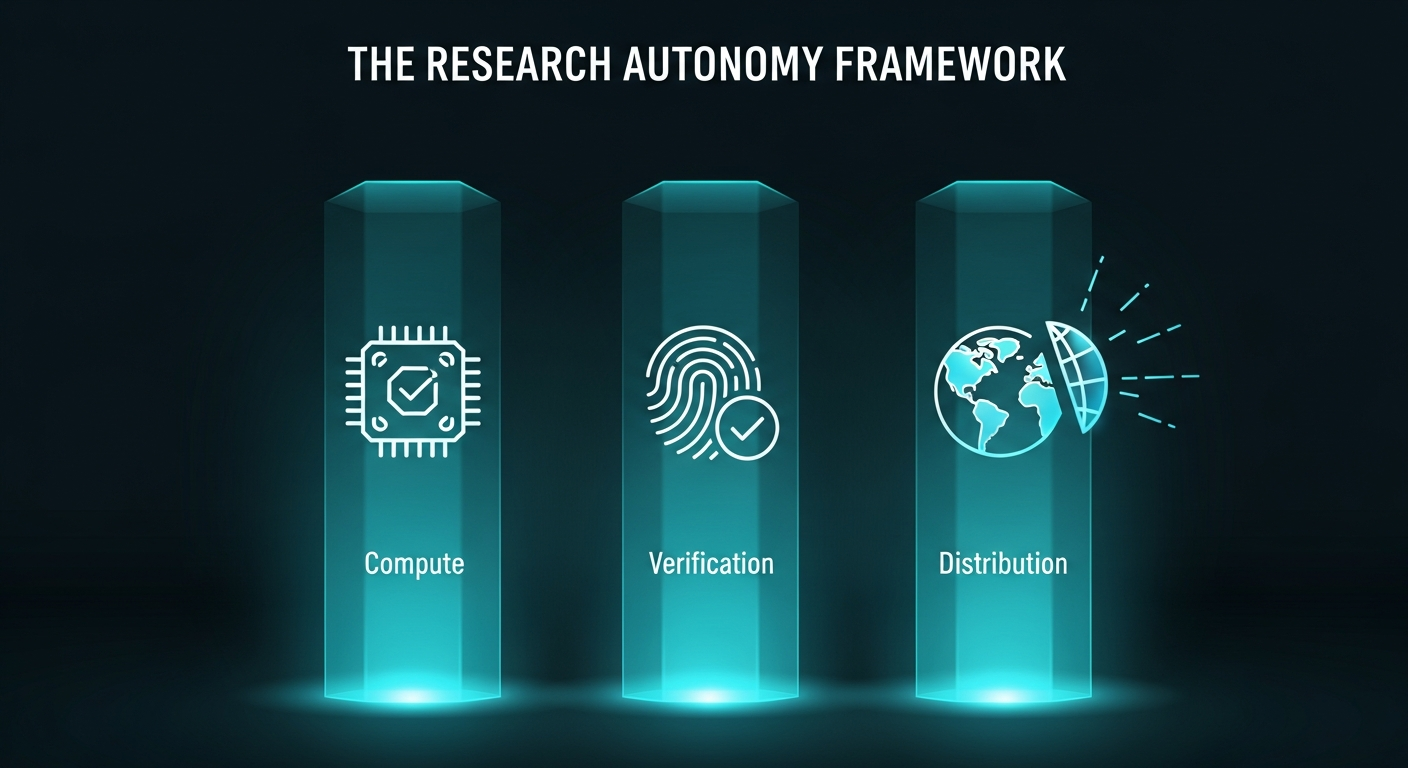
The Research Autonomy Framework
To understand why this changes everything for your career and your access to information, you have to look at what I call the **Research Autonomy Framework**.
This is the three-part system that ArXiv is now building to replace the "Legacy Academy" model.
1. Compute Sovereignty
In the old Cornell model, ArXiv relied on university-allocated server space and slow-moving IT budgets. Independence means they can now partner directly with decentralized compute providers.
**By 2027, we will likely see ArXiv running its own inference engines**, allowing you to "chat" with a paper directly on their site using locally-hosted open-weights models rather than feeding your queries back into a corporate AI.
2. Verification Decentralization
The "Peer Review" system has been broken for a decade, but the rise of AI-generated "slop" papers in 2025 nearly killed it.
ArXiv’s new independence allows them to implement a "Proof of Research" system.
Instead of waiting six months for a journal, researchers will use decentralized identity (DID) to verify their credentials instantly, creating a real-time "trust graph" that legacy universities are too scared to touch.
3. Distribution Neutrality
This is the big one.
**ArXiv can now fight back against "Data Enclosure."** We are currently seeing a trend where major publishers are trying to "partner" with AI labs to put research behind paywalls for "safety reasons." By quitting Cornell, ArXiv is signaling that it will never be part of a corporate data-sharing agreement.
They are the last line of defense for the "Open-Source Intelligence" movement.
The End of the "Paper" as We Know It
We have been stuck in the PDF era for far too long.
A PDF is a digital ghost of a piece of paper; it’s static, hard to search, and impossible for modern AI tools like **Gemini 2.5** to parse perfectly without errors.
ArXiv’s independence is the green light for a total format overhaul.
Within the next 12 months, I expect "The ArXiv Paper" to evolve into a living, interactive document.
Imagine a research paper where the charts are live-coded, the data is accessible via API, and the "Abstract" is a custom-tuned AI summary tailored to your specific expertise level.
**If you are a developer or a tech professional, this is the most important shift in your workflow since the invention of Git.** We are moving away from "reading about" breakthroughs to "interfacing with" them.
The friction between a discovery in a lab and a library you can `npm install` is about to drop to near zero.
Real-World Implications for 2027
If ArXiv succeeds in this transition, the landscape of technical expertise will be unrecognizable by this time next year.
We are looking at a future where "The University" is no longer the gatekeeper of what counts as "Valid Knowledge."
- **For Mid-Level Engineers:** You won't need a Masters's degree to stay ahead.
The new ArXiv will likely feature "Learning Paths" that use AI to bridge the gap between your current skills and the math required to understand the latest papers.

- **For Founders:** The "Research-to-Product" pipeline will accelerate.
You’ll be able to license verified, reproducible data directly from the ArXiv foundation, bypassing the "Academic Transfer Offices" that usually take 18 months to sign a single NDA.
- **For the AI Industry:** This is a shot across the bow.
ArXiv is essentially saying: "You can use our data, but you have to play by our rules." Expect a major standoff between the ArXiv Foundation and the "Big Three" AI labs by the end of 2026.
I’ve personally struggled with the "Academic Paywall" for years.
I remember trying to research a piece on quantum encryption in 2024 and hitting a $45-per-article wall at a major journal, only to find the "pre-print" on ArXiv for free.
**That "free" version was only possible because of the bravery of a few maintainers.** Now, that bravery has been institutionalized.
Who Owns the Truth?
The "Cornell Divorce" is the first major crack in the 19th-century model of higher education.
For 150 years, we believed that knowledge needed to be "housed" in a physical location, guarded by a specific brand-name institution.
**But in the age of ChatGPT 5 and Claude 4.6, knowledge is a fluid, high-velocity asset.** It cannot be "housed"; it can only be "hosted." ArXiv realized that to stay open, it had to stop being a "department" and start being a "protocol."
As we move into the second half of 2026, ask yourself: where do you get your "truth"?
Is it from a legacy institution that moves at the speed of a committee meeting, or is it from a sovereign, independent foundation built for the speed of light?
The era of "Cornell's ArXiv" is over. The era of "Our ArXiv" has just begun. This isn't just a change in hosting; it's the declaration of independence for the human mind.
**Do you think science is safer in the hands of a 150-year-old university, or an independent foundation built specifically for the AI age? Let's talk in the comments.**
---
Story Sources
From the Author




Hey friends, thanks heaps for reading this one! 🙏
If it resonated, sparked an idea, or just made you nod along — I'd be genuinely stoked if you'd show some love. A clap on Medium or a like on Substack helps these pieces reach more people (and keeps this little writing habit going).
→ Pythonpom on Medium ← follow, clap, or just browse more!
→ Pominaus on Substack ← like, restack, or subscribe!
Zero pressure, but if you're in a generous mood and fancy buying me a virtual coffee to fuel the next late-night draft ☕, you can do that here: Buy Me a Coffee — your support (big or tiny) means the world.
Appreciate you taking the time. Let's keep chatting about tech, life hacks, and whatever comes next! ❤️