96% of WebDevs Use LinkedIn Wrong. This Secret Actually Changes Everything.
96% of WebDevs Use LinkedIn Wrong. This Secret Actually Changes Everything.
**Stop using LinkedIn to find a job. I’m serious.
If you’re still clicking “Easy Apply” in March 2026, you’re not just wasting time—you’re actively signaling to the market that you’re a commodity in an era of AI-driven abundance.**
The "Open to Work" green circle? It’s the digital equivalent of wearing a "Please Hire Me" sandwich board in the middle of a desert.
It doesn’t attract water; it attracts vultures, low-tier recruiters, and "hustle-porn" coaches looking for their next victim.
I’ve been a Senior Lead for over a decade, and I’ve sat on both sides of the interviewing table at companies ranging from three-person startups to the FAANG giants.
I’m telling you right now: the way 96% of developers use LinkedIn is fundamentally broken, and it's why a recent r/webdev thread with 1,665 upvotes is filled with engineers screaming into the void that they "never got a job from LinkedIn."
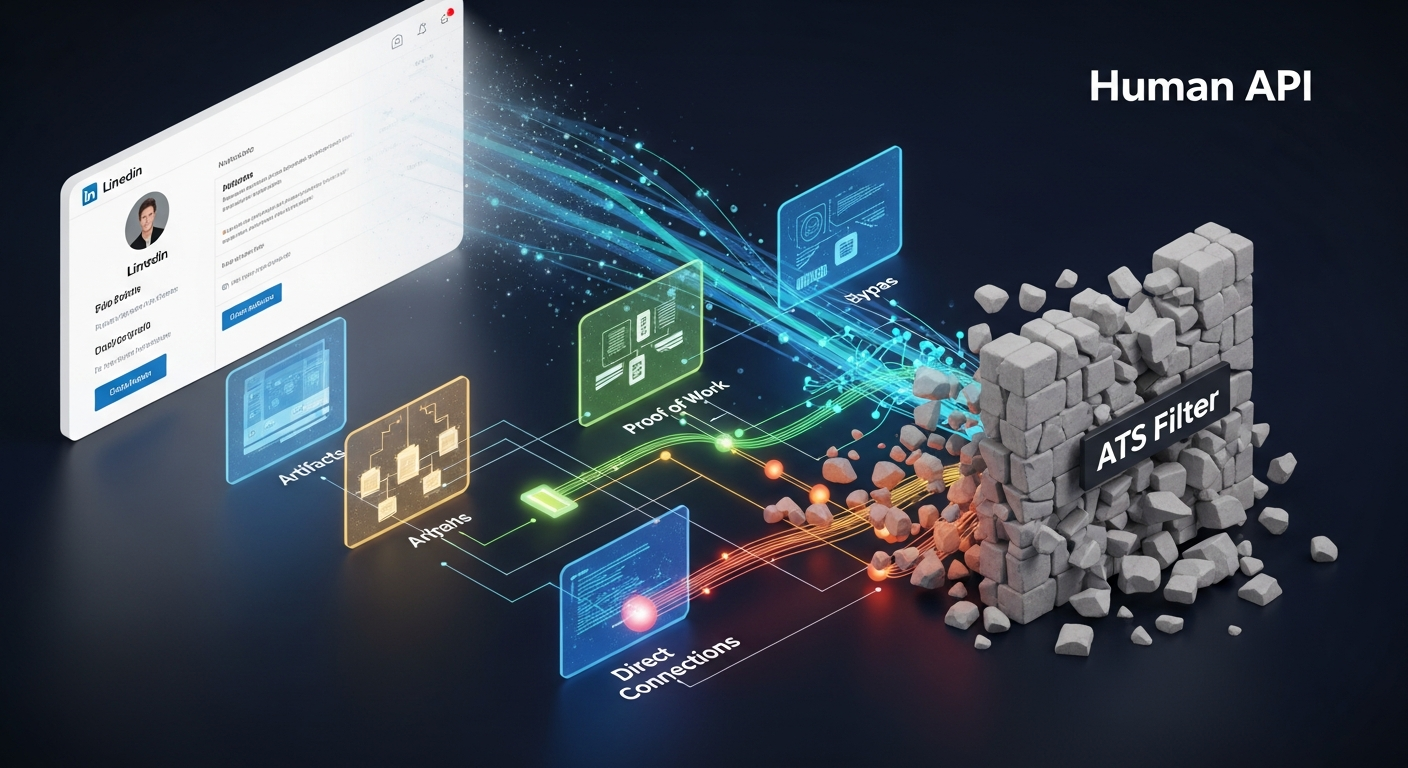
The secret isn't a better resume. It’s not a "polished" profile. It’s treating LinkedIn as a **High-Signal Human API** rather than a social network.
The "Easy Apply" Death Spiral
We need to address the elephant in the room. It is March 2026. We are living in the world of Claude 4.6 and ChatGPT 5.
If you can apply for a job with one click, so can 10,000 other people—and 9,900 of them are using AI agents to mass-spam their resumes.
When you click "Easy Apply," you aren't entering a talent pool. You’re entering a database that is being filtered by an ATS (Applicant Tracking System) that is increasingly cynical.
Recruiters are drowning in "perfect" AI-optimized resumes that all look identical.
**The traditional job board is dead.** In 2025, the average "Easy Apply" role for a React/Node stack received over 4,000 applications in the first six hours.
By the time you hit "Submit," you’re already buried under a mountain of noise that no human will ever actually read.
Why 1,665 Developers Are Currently Furious
The massive engagement on Reddit isn't a fluke. It's a symptom of a systemic failure.
Developers are frustrated because they were told that "networking" means posting "I’m happy to announce" and liking their former manager’s anniversary post.
That isn't networking. That’s digital maintenance. It’s the equivalent of checking the oil in a car that has no engine.
**Most developers treat LinkedIn like a library when it is actually a bazaar.** They sit quietly in the corner, hoping someone picks their book off the shelf.
Meanwhile, the people actually getting hired are the ones setting up a stall, showing off their wares, and shouting (intelligently) about the problems they’ve solved.
The Sacred Cow: Your Resume Doesn't Matter (Anymore)
Everyone tells you to optimize your keywords. Everyone tells you to use the "X-Y-Z" formula for your bullet points. They are wrong.
In 2026, "skills" have become a commodity. If I need a CRUD app built, I can ask an agent to scaffold it in 15 seconds.
If I'm hiring a human, I’m not hiring them for their ability to write a `useEffect` hook.
I’m hiring them for their **architectural taste, their ability to navigate legacy nightmares, and their "Proof of Work."**

Your LinkedIn profile shouldn't be a list of places you’ve sat for 40 hours a week. It should be a curated museum of artifacts.
If I look at your profile and don't see a single "artifact" of your thinking—a technical breakdown, a post-mortem of a failed migration, or a contrarian take on a new framework—you don't exist to me as a high-tier candidate.
The "Human API" Protocol: How to Actually Get Noticed
If you want to be in the 4% of developers who actually get high-paying, remote, interesting work from LinkedIn, you have to stop acting like a "candidate" and start acting like a **Solution Provider.**
Here is the secret protocol that changes the game. It’s built on three pillars: **Aggressive Transparency, Artifact Creation, and the Reverse-Inbound Strategy.**
1. Stop "Announcing" and Start "Extracting"
Nobody cares that you are "excited to start a new journey." It’s corporate noise. It’s the "Live, Laugh, Love" of the tech world.
**Instead, post the "Invisible Work."** Did you spend three hours debugging a weird race condition in your Redis cache yesterday? Don't just fix it and move on.
Write three paragraphs on LinkedIn explaining *how* you found it, *why* it happened, and *what* it cost the business in terms of latency.
When a Hiring Manager (not a recruiter, a *manager*) sees that, they don't see a resume. They see a person who understands the relationship between code and cost. That is the rarest skill in 2026.
2. Build Your "Proof of Work" Engine
In a world of AI-generated content, **human-centric raw technicality** is the only thing that stands out.
If your profile is filled with Claude 4.6-generated "Top 5 Tips for Clean Code," I am going to ignore you.
Show me the "ugly" stuff. Show me the PR comments where you were wrong. Show me the architectural diagram you drew on a napkin that saved $50k in AWS credits.
**Artifacts are the only currency that hasn't been devalued by LLMs.** An artifact is anything that proves you were in the room, making the hard decisions.
Link to your public "Learning Log" or your "Decision Record" repository. This is how you bypass the ATS entirely.
3. The Reverse-Inbound Strategy
Most devs wait for recruiters to message them. This is like waiting for a lightning strike to power your house.
**The 4% do this instead:** They identify 10 companies they actually want to work for. They find the Engineering Managers (EMs) at those companies. They don't message them asking for a job.
They look at what that EM is posting, or what that company’s engineering blog is talking about.
Then, they create an artifact *specifically* for that problem. "Hey [Name], saw your team is migrating to a multi-region setup.
I just wrote a breakdown of how we handled the data consistency issues during our last move at [Company]. Thought it might save you some headaches."
You aren't a "candidate" anymore. You are a peer providing value. When a headcount opens up next month, whose name is at the top of their inbox?
The Problem Nobody Talks About: The "Cringe" Filter
I know what you’re thinking. "I don't want to be one of those LinkedIn 'influencers.' It’s cringe."
You’re right. It is cringe. The "I woke up at 4 AM to code in a cold plunge" people are exhausting. But you’re confusing **Self-Promotion** with **Public Competence.**
The real problem isn't that you’re being "too loud." It’s that you’ve been conditioned to think that doing your job well is enough. It isn't.
In a globalized, AI-accelerated market, if you aren't visible, you are replaceable.
**Silence is a luxury you can no longer afford.** Being "quietly competent" in 2026 is a recipe for being "quietly laid off" when the next automation cycle hits.
What You Should Do Instead (Starting Today)
If you’re currently looking for work, or if you want to be "headhunter-proof" by 2027, stop what you’re doing and execute these three steps:
**Step 1: The Profile Audit.** Delete every generic "skilled in Java, Python, React" buzzword.
Replace your "About" section with a single sentence: "I help [Type of Company] solve [Specific High-Value Problem] by [Your Unique Technical Approach]."
**Step 2: The 2-Post Rule.** For the next 30 days, post twice a week. Not about your feelings. About a **Technical Decision** you made.

Why did you choose Vite over Webpack? Why did you use a SQL database when everyone else is using NoSQL? Explain the trade-offs.
**Step 3: The 10-EM Target.** Find 10 Engineering Managers you respect. Follow them. Don't "connect" yet.
Comment on their technical posts with actual insight—not just "Great post!" Show them you’re a peer.
The Uncomfortable Truth
The reason 96% of web developers are using LinkedIn wrong is that they are waiting for a permission slip. They are waiting for a recruiter to tell them they are "worthy" of an interview.
**Nobody is coming to save you.** There is no "meritocracy" that automatically rewards the best coder who sits in the dark.
The "merit" in 2026 is a combination of your technical depth and your ability to communicate that depth to other humans.
How many hours have you spent "polishing" your resume in the last month? Now, how many hours have you spent building a public record of your expertise?
If the ratio is 10:1, you’re playing a game that ended three years ago.
**Have you actually landed a high-quality job through LinkedIn in the last 12 months, or has it just been a black hole of ghosting and automated rejection? Let's get real in the comments.**
---
Story Sources
From the Author




Hey friends, thanks heaps for reading this one! 🙏
If it resonated, sparked an idea, or just made you nod along — I'd be genuinely stoked if you'd show some love. A clap on Medium or a like on Substack helps these pieces reach more people (and keeps this little writing habit going).
→ Pythonpom on Medium ← follow, clap, or just browse more!
→ Pominaus on Substack ← like, restack, or subscribe!
Zero pressure, but if you're in a generous mood and fancy buying me a virtual coffee to fuel the next late-night draft ☕, you can do that here: Buy Me a Coffee — your support (big or tiny) means the world.
Appreciate you taking the time. Let's keep chatting about tech, life hacks, and whatever comes next! ❤️